Viral cat POV videos on TikTok share four things: a clear story in 7-15 seconds, footage captured at peak activity hour, a hook in the first second, and either genuine discovery or genuine cuteness. Hardware matters less than most people think — it's the editing and moment selection that makes Mr. Kitters average 5 million views per video and not 50,000.
This guide is for people who've seen the big cat POV accounts and want to understand how they actually work. Not the hype version. The real one, with timing, editing, and a realistic timeline. If you're expecting "go viral overnight," stop reading. If you want the actual mechanics behind the format that's dominating #cattok in 2026, keep going.
What's Actually Trending in 2026
Cat POV isn't a niche anymore. Mr. Kitters(@mr.kitters.the.cat) sits at the top of the format, averaging around 5 million views per short clip and pushing 90 million on some of his longer compilations. Snowy, an outdoor cat whose single POV video hit 37 million views, turned the "day in the life" subformat into the dominant template. Niko and Cat.Mandoare the next tier down, each with their own variation — urban vs. rural, indoor vs. roaming.
The hashtag ecosystem is tight: #catcam, #catpov, #cattok, #catsdaily, #dayinthelife, and #fyp as the catch-all. Mixing two cat-specific tags with one broad discovery tag is the pattern that currently performs best.
Two formats dominate. The first is the 10-25 second clip with a clean story arc — exit home, discover something, return. The second is the 8-12 minute compilation stitched from a full day of footage, which now regularly crosses 10 million views on the bigger accounts. TikTok's 2026 algorithm prioritizes rewatch rate and comment velocity over raw like counts, which is why a 9-second loop can outperform a polished 60-second edit.
The Hardware You Actually Need
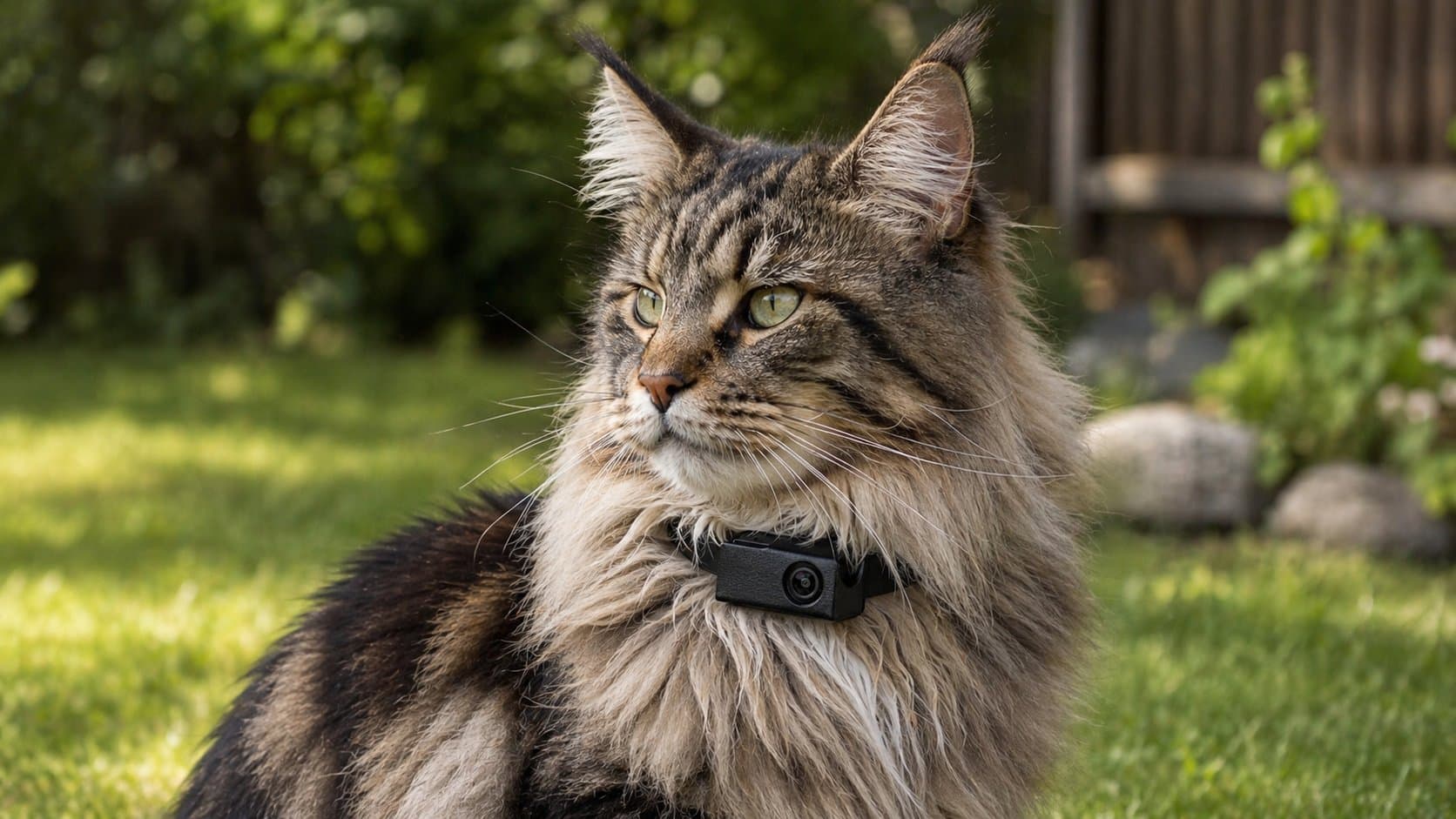
There are roughly three tiers, and most people dramatically overspend on the first purchase. Entry level is a sub-$50 collar camera — a Whiskcam Original or equivalent, around 26 g, 1080p, no app required. For the first 80% of creators, this is enough to shoot videos that can break through. You're not losing views because your camera isn't 4K.
Mid tier is the Insta360 Go 3 at around $380, which is what Mr. Kitters currently shoots with. The advantage is stabilization, better low-light performance, and magnetic mounting. The disadvantage is size, weight, and the fact that it's overkill for a cat who hasn't started pulling numbers yet.
Pro tier is a multi-camera setup paired with Premiere or DaVinci Resolve. Not necessary for phase one, and honestly not necessary until you're past 100k followers.
Worth remembering: Mr. Kitters started on a cheap camera before upgrading to the Insta360. The content worked first, then the hardware caught up. If you flip that order, you'll end up with expensive footage of a cat who naps through 90% of your recording window.
The Golden Hour (And Why Most People Film at the Wrong Time)
Cats are crepuscular. They're most active in the 30 minutes after sunrise and the 30 minutes before sunset. Film at noon and you'll get a cat who sleeps, grooms for 90 seconds, then sleeps again. Film at dusk and the same cat is hunting, climbing, and reacting to things.
For indoor cats, the practical windows are roughly 10-11 AM and 5-7 PM, usually tied to feeding time. Outdoor cats peak at dusk — that's when prey animals come out, and that's when most of the interesting confrontation footage happens. If you have a cat who uses a cat flap, opening it at 6 PM in summer is the single highest-leverage thing you can do for content.
The math is brutal but consistent: same cat, same camera, a 90-minute session at 5 PM will produce roughly 3x more usable clips than the same session at 2 PM. Mid-afternoon sessions routinely yield zero usable moments despite recording for hours. Golden hour sessions rarely do.
For one viral 15-second clip, you should expect to sort through 1-2 hours of raw footage. That ratio is already generous. At the wrong time of day it blows out to something like 0 moments from 3 hours of recording, which is how most people conclude the camera is broken when the problem is the calendar.
The 7-Second Story Arc
The single most viral structure on cat TikTok right now: Hook (0-1s), Setup (1-4s), Payoff (4-7s). That's it. Every short Mr. Kitters clip that crosses a million views follows some variant of this curve.
A concrete example. Hook: cat jumps off the couch, camera swings fast — that motion in the first frame is what stops a scroll. Setup: cat walks through the kitchen, camera passes an open fridge. Payoff: cat swipes a slice of ham off the lower shelf. Seven seconds. Clear story. Rewatchable.
A bad example: 15 seconds of cat walking through a hallway without finding anything. No hook, no setup, no payoff. Scroll past within 2 seconds.
The test is simple. If you can summarize the video in 5 words — "cat discovers X," "cat confronts Y," "cat escapes Z" — you have a video. If you can't, you have footage. The difference matters. Roughly 80% of raw recordings are footage, not videos, and most of the editing work is identifying which 5% of clips can carry a 5-word summary.
The 7-second window isn't arbitrary. It's the average attention budget a TikTok viewer gives an unknown creator before deciding to stay. Longer formats still work, but they have to earn their extra seconds.
What to Actually Film
Five categories consistently outperform everything else. In rough order of reliability:
"First time" moments. First outdoor recording. First time meeting another cat. First snow. First encounter with a bird. First-time content carries natural novelty, and novelty is the single strongest signal for TikTok's algorithm. Snowy's 37M-view clip was effectively a first-time outdoor compilation.
Discovery moments. Cat finds a hidden spot, cat intercepts a delivery person, cat "catches" a neighbor doing something unremarkable. The viewer sees the reveal alongside the cat, which is the emotional hook of the entire POV format.
POV perspective flex. A cat jumping onto a 2-meter shelf looks dramatic from a collar camera. A cat passing under a low bench looks like a cinematic crawl shot. These are moments where the POV itself is the story — they don't need a narrative beyond the physics.
Mundane made weird. A cat grooming from ground level becomes strangely hypnotic. A cat jumping onto a bed becomes a first-person launch sequence. The routine is familiar; the POV makes it new.
Confrontation. Another cat on the wall, a cautious dog, a squirrel at eye level. Visual tension stops a scroll almost automatically. The stare-down format — two cats holding eye contact for 15-20 seconds — has been one of the strongest performers of 2026.
What to avoid: long walk-and-walk footage with no destination, night-time low-light clips (grainy, looks bad, doesn't rewatch), and 10-minute stretches of sleeping. A cat sleeping on a couch is not content. It's your cat's personal time that you happened to record.
Editing That Converts Views to Follows
Length first. The sweet spots in 2026 are 8-15 seconds for a hit-driven clip, 30-60 seconds for a story-driven narrative, and 5-10 minutes for a compilation. Anything between 20 and 28 seconds seems to underperform consistently — too long for the short window, too short to earn the mid window.
Captions are non-negotiable. Even without voiceover, TikTok's algorithm favors videos with on-screen text, and roughly 60% of users watch with sound off on the first view. Bare clip, no text, no caption = you're leaving half the reach on the table.
Audio in 2026 is about trending sounds over original audio by a wide margin. Check TikTok's Sound library weekly — the specific sound that works changes every 7-14 days, but the principle holds. Original audio only works for creators already past 100k followers, where the audience is tuning in for the voice.
Cut every 1-2 seconds. Even 2 seconds of static action without a new beat is enough to lose viewers. The worst thing a cat POV clip can do is linger on a single moment for 4-5 seconds.
Outro: either resolve the story arc cleanly or engineer a perfect loop so the viewer doesn't realize the video restarted. Cutting mid-action without either resolution or loop is the single most common mistake and kills rewatch rate.
Safety and Ethics Before You Post
A breakaway collar is non-negotiable for any outdoor cat wearing a camera. Not optional, not a maybe — breakaway. We covered the full safety logic in our piece on whether cat collar cameras are safe, but the short version is that a camera adds weight and snag risk, and the only acceptable mitigation is a collar that releases under pressure.
Privacy matters too. If your cat wanders into a neighbor's property and the camera captures the interior of their home, that's footage you shouldn't post. Outdoor spaces visible from the street are generally fine; living rooms through windows are not.
Audio is even stricter than video in most jurisdictions. Recording private conversations — even inadvertently — can violate consent laws in several U.S. states and most of Europe. If you're uncertain, strip the audio and use a trending sound instead. That's better for the algorithm anyway.
Finally: some cats refuse the camera. They scratch it off, sulk, change their behavior. About 1 in 10 cats, based on informal owner reports, never adapts. If your cat is in that group, accept it and move on. Forcing a reluctant cat is both ethically bad and produces footage that performs worse, because the discomfort is visible on camera.
How Long Until You Hit Viral?
The honest answer: most cat POV creators post between 50 and 100 videos before their first real hit. Not 5. Not 10. Fifty to a hundred. The people who go viral on clip #3 exist, but they're statistical outliers and usually already have a cat with an unusually photogenic face or distinctive coat.
The cadence that works: one video per day, minimum, for 60 days. Less than that and you don't give the algorithm enough data to figure out who your audience is.
TikTok in 2026 runs something close to a 100-video calibration window. Your first hundred videos are tested on progressively larger micro-audiences, and most accounts see their first genuine hit somewhere between video #47 and video #60. Before that point, 200-500 view clips are normal and not a signal of failure. After that point, you're compounding.
If you've posted 3 clips, got 400 views each, and concluded the format isn't working for you, you've stopped at the worst possible moment. It's not the camera. It's not the cat. It's the sample size.
A Realistic 30-Day Plan
A concrete schedule for someone starting from zero, based on what actually works for the creators who've broken through in the last 12 months.
Days 1-3: Setup. Fit the camera and let the cat get used to it. Short 10-15 minute sessions. No pressure to produce anything. Most cats adapt within 20 minutes; some take two days.
Days 4-7: Daily 90-minute sessions at golden hour. One session per day, same time each day. This is pure data collection — you are not editing yet. Your job is to build a footage library.
Days 8-10: Review and tag. Scrub through all of the footage at 4x speed. Identify 5-7 moments that meet the 5-word summary test. Everything else goes in an archive folder.
Days 11-20: Post one video per day. Vary the format: some 7-second clips, some 15-second, some 30-second. Use trending sounds. Include captions. Don't post twice a day — it splits the algorithm's attention.
Days 21-30: Analyze and double down. Look at which 2-3 videos outperformed the rest by at least 3x. Whatever structure they share — hook type, length, time of day filmed — is your format. Next month, lean into it.
Frequently Asked Questions
Can any cat be a viral TikTok cat?
Honestly, no. Temperament matters more than looks. A calm, curious cat who tolerates a collar and explores actively will outperform a gorgeous-but-anxious cat every time. About 1 in 10 cats refuses the camera entirely, and another 20-30% will tolerate it but won't give you interesting footage because their baseline behavior is too sedentary. If your cat sleeps 20 hours a day and hates doorways, the format probably isn't for you.
Do I need 4K to go viral?
No. 1080p is more than enough for TikTok, which compresses everything anyway. The visible quality difference between a $50 1080p collar camera and a $400 4K rig disappears almost entirely after TikTok's upload pipeline processes the file. What separates viral clips from forgettable ones is never resolution. It's moment selection, edit pace, and audio choice.
What camera does Mr. Kitters use?
Publicly, he uses an Insta360 Go 3 paired with a Furee harness — both mentioned in several of his own behind-the-scenes clips. Price together lands somewhere around $450. Worth noting: he started the account on a much cheaper setup and only upgraded after his format was already working. The gear is a consequence of his growth, not the cause of it.
How many views is considered viral for a cat video?
The rough thresholds in 2026: 100,000 views is a genuine hit — your video broke out of your usual audience and reached strangers. 1 million views is viral by any reasonable definition. 10 million and up is top-tier cat content for the year. Most accounts that eventually break through spend weeks or months in the 500-5,000 view range before the first 100k-plus clip lands.
The Bottom Line
Your cat is already unique. The camera is just a way to show that. The hardware is a tool, not a shortcut — the Mr. Kitters of 2027 is currently filming with something cheap, iterating on cadence, and getting 600 views a video. If you want to see what a week of serious recording actually produces, we wrote about it in detail in I filmed my cat for 7 days — what I learned. If you want the camera we use, the Whiskcam Original is 26 g, 1080p, and priced for exactly this phase of a creator's timeline.