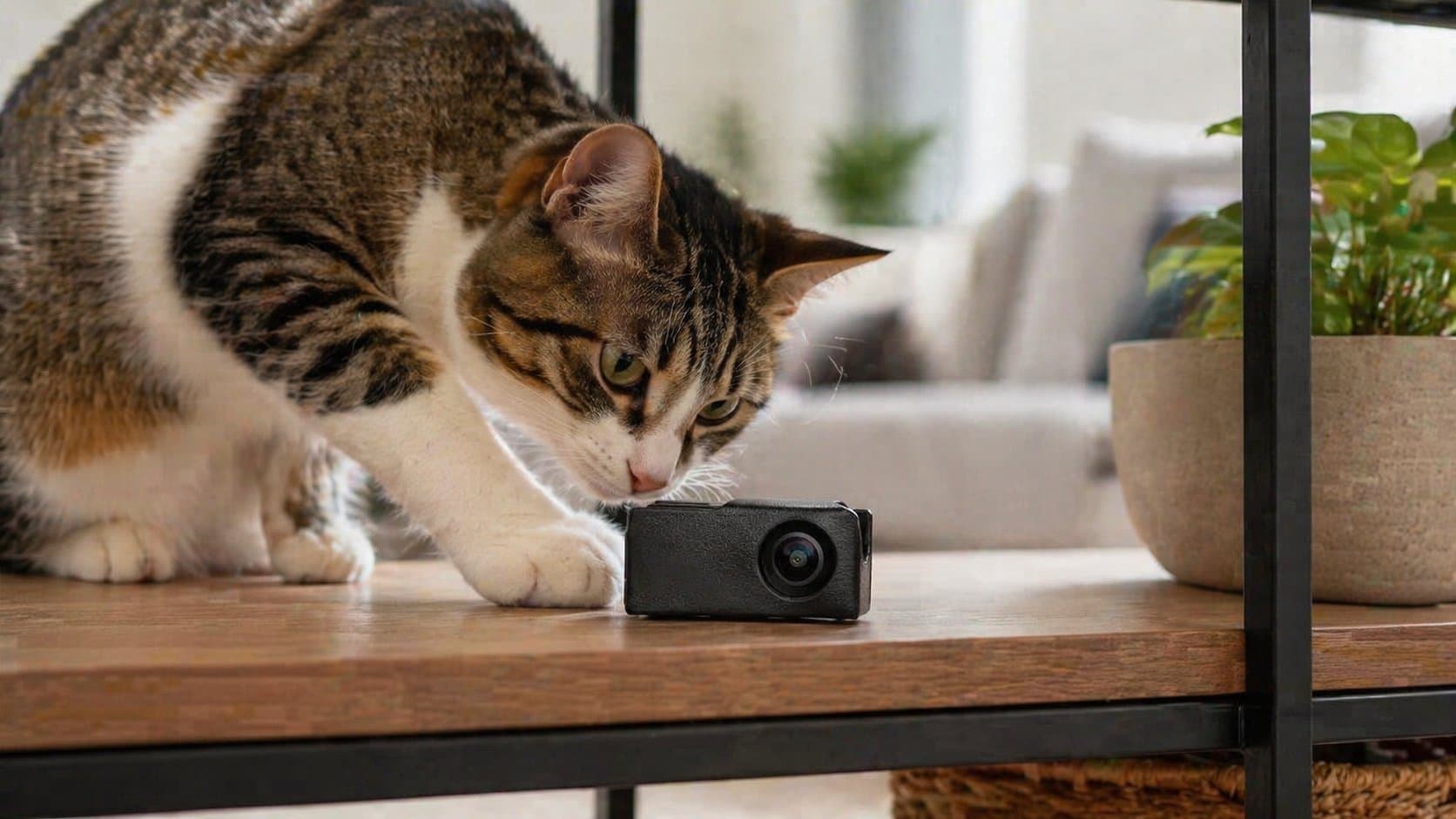
Short answer: yes, with two non-negotiable conditions — a breakaway collar and a camera under 5% of your cat's body weight (ideally under 3%). For a 4 kg cat that means a camera under 200 g, and every dedicated cat collar camera on the market is far lighter than that (20-40 g). Most cats stop noticing the camera within 5-10 minutes.
The non-obvious risks are not the weight itself — they are collar entanglement on outdoor cats and behavioural stress on cats who weren't introduced gradually. We'll cover both. The 3-5% rule comes out of wildlife telemetry research from the 1990s (Cochran & Lord, Murray & Fuller); veterinary behaviourists have since adopted it for pet wearables.
Disclosure: I work on Whiskcam, which makes a 24 g cat collar camera, so I have a bias. The numbers below come from peer-reviewed wildlife telemetry guidelines (3-5% body-weight rule) and from the safety protocol our team uses on our own cats — a breakaway collar, a slow indoor introduction, and a hard rule of stopping the session if the cat freezes.
The Weight Rule: How Heavy Is Too Heavy?
The widely cited guideline from wildlife telemetry research is that devices worn by animals should weigh no more than 3-5% of the animal's body weight. This guideline comes from decades of tracking studies on wild animals and has been adopted by veterinarians for pet wearables.
Here's what that means in practice:
| Cat Weight | 3% Limit | 5% Limit | Typical Collar Camera |
|---|---|---|---|
| 2 kg (small adult) | 60 g | 100 g | 26-38 g (safe) |
| 4 kg (average cat) | 120 g | 200 g | 26-38 g (safe) |
| 6 kg (large cat) | 180 g | 300 g | 26-38 g (safe) |
As you can see, even the lightest adult cat (2 kg) has a safe limit of 60 g at the conservative 3% threshold. The heaviest collar cameras on the market (around 40 g) are well below this limit. A 24 g camera like the Whiskcam represents just 1.3% of a 2 kg cat's body weight.
What is the safe camera weight for your cat?
Enter your cat's weight. The limits come from the 3–5% body-weight rule veterinarians apply to wearables.
4.0 kg cat, 24 g camera: Within the conservative 3% limit.
Weight is only half of it. A breakaway collar matters more than a few grams — entanglement is the risk that actually injures outdoor cats. Read the collar section below before you buy anything.
Important: This guideline applies to adult cats. Do not put a collar camera on kittens under 2 kg. Their bodies are still developing, and the proportional weight is much higher.
Why You Must Use a Breakaway Collar
A breakaway collar (also called a safety collar or quick-release collar) has a clasp that opens under pressure. If your cat's collar gets caught on a branch, fence, or furniture, the collar releases instead of choking your cat.
This is non-negotiable for outdoor cats. Indoor cats are at lower risk, but a breakaway collar is still recommended. The camera and collar should never be more important than your cat's safety.
Most collar cameras attach to the collar via a clip or mount, so if the breakaway collar releases, the camera goes with it. You might lose the camera, but your cat stays safe. That's the right trade-off.
How to Tell If Your Cat Is Uncomfortable
Most cats adapt to a collar camera within 5-15 minutes. But every cat is different. Watch for these signs during the first few sessions:
Normal reactions (usually pass in 5-15 minutes)
- Briefly pawing at the camera or collar
- Walking slightly lower to the ground for the first few minutes
- Looking at or sniffing the camera
- Shaking their head once or twice
Signs to remove the camera immediately
- Persistent scratching at the collar for more than 10 minutes
- Refusing to move or "freezing" in place
- Excessive vocalization (meowing, hissing)
- Trying to bite or rip the camera off
- Loss of balance or stumbling
- Hiding and refusing to come out
If your cat shows persistent distress, remove the camera and try again another day with a shorter session. Some cats take 3-4 attempts to fully adjust. A very small percentage of cats may never accept wearing a camera — and that's okay.
Indoor vs Outdoor: Different Safety Considerations
Indoor use
Indoor use is lower risk. There are no tree branches, fences, or other cats to worry about. The main concerns are:
- Getting caught on furniture (use a breakaway collar)
- The camera falling off and being chewed on (check that the clip is secure)
- Battery overheating (extremely rare, but don't leave a charging camera attached to your cat)
Outdoor use
Outdoor use is where collar cameras shine — but it's also where safety matters most. Additional precautions for outdoor use:
- Breakaway collar is mandatory — no exceptions
- Start with supervised outdoor sessions before letting your cat roam freely
- Check that the camera mount is tight and won't snag on branches
- Don't use the camera in rain or wet conditions unless it's waterproof
- Even with up to 2 hours of battery, check on your cat regularly — don't rely on them to "come home" when the battery dies
Which Cats Should Not Wear a Collar Camera?
Collar cameras are not suitable for every cat. Avoid using one on:
- Kittens under 2 kg — proportional weight is too high, and they're still growing
- Elderly cats with mobility issues — even a light camera can affect balance in cats with arthritis or joint problems
- Cats recovering from surgery or illness — don't add any stress to their recovery
- Cats that have never worn a collar — introduce a plain collar first, then add the camera after they're comfortable (1-2 weeks)
- Cats that panic with any collar — some cats simply don't tolerate collars, and that's okay
What Veterinarians Recommend
Veterinarians generally consider lightweight collar cameras safe for healthy adult cats, with consistent recommendations:
- Keep the total collar + camera weight under 3-5% of body weight
- Use a breakaway collar, especially outdoors
- Introduce the camera gradually — short sessions first
- Monitor your cat's behavior for the first few uses
- Don't leave the camera on 24/7 — give your cat breaks
If you have specific concerns about your cat, consult your vet. They know your cat's health history and can give personalized advice.
Tips for First-Time Use
Follow these steps to make the first experience positive for your cat:
- Day 1-3: Let your cat sniff and investigate the camera while it's not attached to anything. Place it near their food or bed.
- Day 4-7: If your cat doesn't already wear a collar, introduce a plain collar (no camera). Let them wear it for increasing periods — 10 minutes, 30 minutes, 1 hour.
- First camera session: Attach the camera to the collar. Stay in the same room. Start with 15-30 minutes indoors. Reward your cat with treats.
- Second session: Extend to 45-60 minutes. If your cat is comfortable, let them have access to their usual spaces.
- Outdoor session: Only after 2-3 successful indoor sessions. Stay nearby for the first outdoor use.
Frequently Asked Questions About Cat Camera Safety
Can a collar camera hurt my cat's neck?
Not if the camera is lightweight (under 40 g) and the collar fits properly. The collar should be snug enough that you can fit two fingers between the collar and your cat's neck, but not so loose that it slides around. A properly fitted collar with a light camera distributes the weight evenly and won't strain your cat's neck.
Will my cat try to eat the camera?
It's unlikely. Collar cameras are too large to swallow and aren't food-shaped. The bigger risk is a cat pawing at the camera and knocking it off the collar. Make sure the mounting clip is secure. If the camera does fall off, pick it up before your cat investigates it as a toy.
Can the camera overheat?
Dedicated collar cameras are designed for the heat generated during recording. They don't get hot enough to burn skin or fur. That said, don't charge the camera while it's attached to your cat — always remove it for charging.
Is it legal to record with a cat collar camera?
In most countries, recording video in public spaces is legal. However, audio recording laws vary by jurisdiction. Some regions require consent to record audio. Since collar cameras primarily capture your cat's outdoor adventures (not private conversations), this is rarely an issue. If your cat frequently enters neighbors' properties, be aware of local privacy laws.
Should I use a collar camera or a harness mount?
For cats, collar mounting is easier and lighter. Harness mounts are better suited for dogs, who are used to wearing harnesses. Most cats don't tolerate harnesses well, and the added bulk defeats the purpose of using a lightweight camera.
The Bottom Line
Cat collar cameras are safe for healthy adult cats when you follow basic precautions: use a lightweight camera (under 40 g), use a breakaway collar, introduce it gradually, and respect your cat's limits. The vast majority of cats adapt quickly and the footage you get is worth the small effort of introduction.
If you're looking for a collar camera, check our comparison of the best cat collar cameras in 2026. Or learn more about the Whiskcam Original, our 24 g collar camera designed for cats.