Skip to content

Save 44% Free shipping worldwide

insta360 go 3cat pov cameracat collar cameracamera comparison

Whiskcam vs Insta360 Go 3 for Cat Collar Use: Honest 2026 Comparison

By Whiskcam Team··9 min read

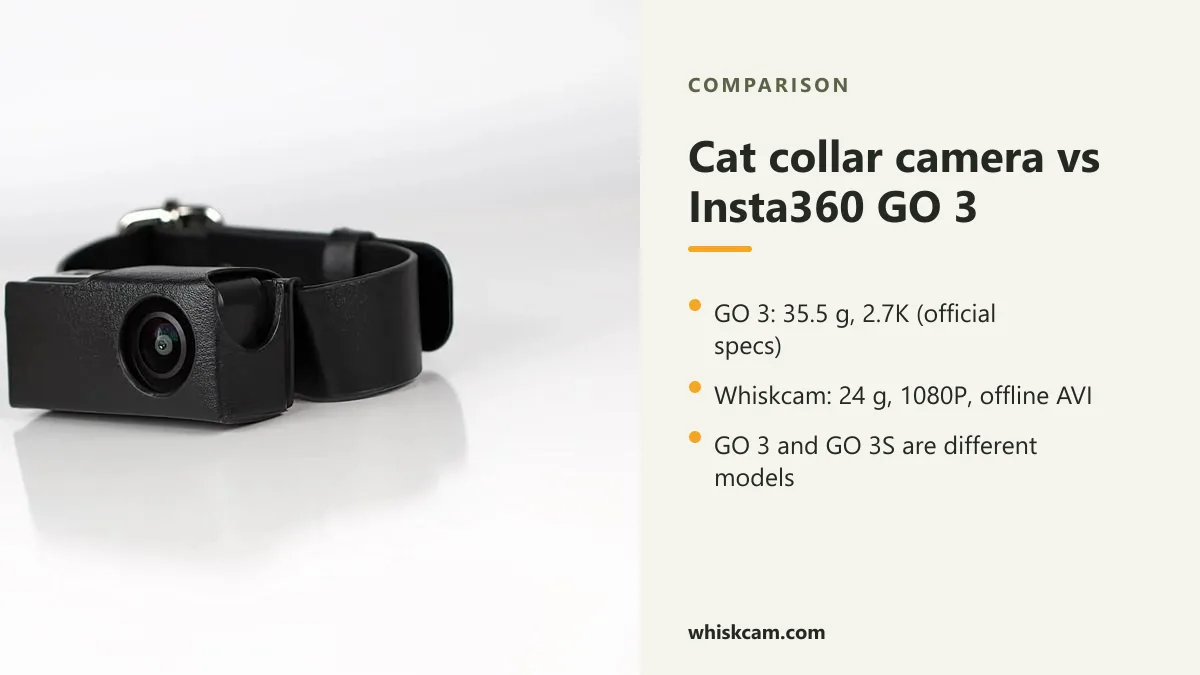
Insta360 Go 3 is the premium choice — 4K, WiFi, waterproof, around $380. Whiskcam is the pet-specific choice — 26 g, 1080P, $49.90, no app, with a breakaway safety collar included. For most cat owners, the honest answer depends on two questions: your cat's size and whether you want to shoot content seriously or just see what your cat does.

Cat POV content exploded on TikTok in 2024-2025. Channels like Mr. Kitters The Cat (37M+ cumulative views) and Niko built entire audiences on collar-mounted footage, and both use the Insta360 Go 3. They do a genuinely great job — the stabilization, the colors, and the editing are all excellent. If you've landed here after watching their videos, you're in the right place.

This article is written by the Whiskcam team. We make a $49.90 pet-specific collar camera, so we have a bias — we'll flag it where it matters. But the goal here is factual: where the Insta360 Go 3 wins, where Whiskcam wins, and which one fits your situation. We are not going to pretend a 1080P pet camera beats a 4K action camera on video quality. It doesn't.

Side-by-Side Specs

Both cameras are capable. They're built for different buyers. Here's the head-to-head on the specs that actually decide which one you should own.

SpecInsta360 Go 3Whiskcam OriginalWinner
Weight (camera only)~35 g26 g (with mount)Whiskcam
Weight on collar (with mount)~39-42 g26 gWhiskcam
Resolution2.7K (Go 3) / 4K (Go 3S)1080PInsta360
Field of view~120°170°Whiskcam (for POV)
StabilizationFlowState (excellent)NoneInsta360
Battery life~45 min (4K continuous)90-120 min (1080P)Whiskcam
StorageBuilt-in 64 GB or 128 GB32 GB MicroSD includedTie
App requiredYes (iOS/Android)NoDepends on user
WaterproofIPX4 (Go 3) / IPX8 with PodSplash-resistant onlyInsta360
Night modeNo dedicated modeNoTie
Price (USD)~$380 (64 GB)$49.90Whiskcam
Breakaway collar includedNoYes (39 cm)Whiskcam
Setup time~15-20 min (app, account, pairing)~60 seconds (press record)Whiskcam
Target userContent creatorCat ownerDepends

Insta360 Go 3 wins on resolution, stabilization, and waterproofing. Whiskcam wins on weight, battery, setup simplicity, bundled collar, and price. That's not a rhetorical split — it's the actual trade-off.

Weight on a Cat: Why 12 Grams Matters More Than You Think

The Insta360 Go 3 by itself weighs around 35 g. But you can't clip it to a collar bare — you need a magnetic pendant or lanyard mount. In practice, the total load on the collar lands at 39-42 g depending on the mount you use. Whiskcam is 26 g total, mount included.

On a 3 kg cat (small adult, Munchkin, Siamese, young adult), that difference matters:

  • Insta360 Go 3 + mount: 40 g on a 3 kg cat = 1.33% of body weight
  • Whiskcam: 26 g on a 3 kg cat = 0.87% of body weight

On a 4 kg cat (average Domestic Shorthair):

  • Insta360 Go 3 + mount: 40 g = 1.00% of body weight
  • Whiskcam: 26 g = 0.65% of body weight

Both setups clear the 3% veterinary threshold comfortably. For a healthy 4 kg+ cat, both are safe by a wide margin. The gap opens up for small cats, senior cats, or cats with early arthritis: 12 g can be the difference between "the cat ignores it after two minutes" and "the cat lowers its posture and keeps trying to rub the collar off on the couch." If you want the full breakdown by breed, our cat collar weight chart by size has the numbers.

Video Quality: 4K Sounds Great, But...

The Insta360 Go 3 shoots 2.7K at 30 fps (Go 3S pushes 4K at 30 fps). FlowState stabilization is genuinely best-in-class — the footage looks smooth even when the camera is swinging under a cat's chest at a full sprint. Whiskcam is 1080P at 30 fps with no electronic stabilization. On a spec sheet, it's not close.

Here's the reality check. TikTok compresses video aggressively, caps mobile playback at 720P on most phones, and the vertical feed crops the frame. Reels and Shorts behave the same way. On a phone screen, in a fast-moving POV feed with motion blur, the 4K-vs-1080P delta is largely invisible. What people actually respond to is framing, subject behavior, and cuts — not resolution.

Where 4K does earn its keep: YouTube long-form (full desktop playback shows the difference), post-production where you zoom or re-frame from 4K source down to 1080P export, and color grading that holds up under scrutiny. If you plan to build a proper content channel, 4K is a real tool. If you plan to watch what your cat did yesterday and maybe post a 15-second clip, 1080P is indistinguishable on the delivery platform.

Stabilization is the other gap. FlowState genuinely softens a cat's bouncy gait. Whiskcam footage is shakier — it's fine for casual viewing, noticeably rougher for content work.

The App Question

The Insta360 Go 3 requires the Insta360 app for first-time setup, live preview, file transfer, editing, and firmware updates. You create an account, pair over WiFi, grant storage permissions, and learn the interface. The app is well-built and powerful — AI reframing, template edits, auto-cuts, and direct export to TikTok are part of the package. For a creator, that pipeline is half the reason to buy it.

Whiskcam has no app. You charge it over USB-C, press the button once to start recording, press again to stop, pop out the MicroSD card, and copy the files. That's the full interaction model. No account, no permissions, no firmware update prompts, no WiFi pairing that fails twice before it works.

For a creator posting several videos a week, the Insta360 app is a feature, not friction. For a parent checking on their cat between work calls, it's one more app on their phone they didn't ask for.

One honest note about Whiskcam: current units output AVI files rather than MP4. Most modern players (VLC, Windows Photos, Mac QuickTime with a codec) handle them fine, but iPhone Photos doesn't open AVI natively. We wrote a short guide on how to watch AVI files on iPhone if you hit that. Insta360 avoids this entirely — it exports MP4 and its own .insv format.

Safety: The Breakaway Collar Gap

The Insta360 Go 3 ships with magnetic pendants, a pivot stand, and a clip — all designed for human bodies, bags, and hats. There is no breakaway cat collar in the box. Creators like Mr. Kitters work around this by mounting the Go 3 on a Furee cat harness, which is a valid solution but adds roughly $30-40 and a second layer of setup.

Whiskcam ships with a 39 cm adjustable breakaway safety collar — the plastic buckle is designed to pop open under roughly 1-2 kg of pulling force. If your cat snags the camera on a fence, a branch, or a gap under a shed, the collar releases and the cat walks away. Without a breakaway, a snagged collar camera is how outdoor cats end up hanging.

If you buy the Insta360 Go 3 for cat use, budget at least $10-15 extra for a breakaway-compatible mount or a proper cat harness with a breakaway link. Don't skip this. A $380 camera that kills your cat is not a good deal. For indoor-only cats, the risk is lower, but any cat that has ever squeezed under furniture can still get a rigid mount caught.

Battery and Session Length

The Insta360 Go 3 camera pod runs about 45 minutes of continuous 4K recording on its own. Docked inside the Action Pod, total runtime extends to around 170 minutes — but the Action Pod is roughly the size of a GoPro and isn't practical to mount on a cat's collar. For collar use, you're on the bare pod's 45 minutes.

Whiskcam records 90-120 minutes of 1080P on a single charge. For a typical cat patrol — a morning garden loop, an evening neighborhood round, a rainy afternoon window session — 90 minutes usually covers the whole outing with margin.

If you plan half-day outdoor hikes with a leashed adventure cat, you'll want to carry a charger either way. For standard cat behavior, Whiskcam's battery lasts about 2x longer per session on collar.

Price and What You Actually Get

The Insta360 Go 3 retails at around $380 for the 64 GB version and $450 for the 128 GB. Budget another $10-15 for a breakaway-compatible cat mount or a $30-40 harness. Total entry cost: roughly $405-475.

Whiskcam is $49.90 all-in. The box includes the camera, a 32 GB MicroSD card, the 39 cm breakaway collar, a USB-C charging cable, a USB-C-to-Lightning phone adapter for transferring footage, and a PDF quick-start guide. Total entry cost: $49.90.

That's an 8-9x price gap. The honest read: Insta360 Go 3 earns its price if you're serious about building a cat POV channel, if you're going to film yourself and other subjects with the same camera, or if you already live inside the Insta360 ecosystem for travel or sports. For amateur "I want to see what my cat does outside" usage, spending 8x more for 4K that gets compressed back to 720P on TikTok is hard to justify.

Who Should Buy Which

Pick based on intent, not specs.

Buy the Insta360 Go 3 if:

  • You're building a content channel and treating it seriously
  • You need 4K source for YouTube long-form or zoom-in edits
  • You already own Insta360 gear and use the app daily
  • Your cat is 4.5 kg or heavier and 40 g of load is a non-issue
  • Your budget is flexible and you want the best available image quality
  • You'll also use the camera for travel, sports, or first-person video

Buy Whiskcam if:

  • This is your first cat camera and you're not sure the cat will tolerate one
  • You mostly want to see what your cat does — posting is secondary
  • Your cat weighs under 4 kg
  • Your budget is under $100
  • You hate apps, accounts, and firmware updates
  • You want a breakaway collar included rather than sourced separately

Skip both if:

  • Your cat is a kitten under 2 kg — wait until they're 6 months and 2 kg+
  • Your cat is a senior with diagnosed arthritis or cervical issues
  • Your cat has previously panicked and flattened every time you put a collar on them

What Mr. Kitters and Other Creators Actually Use

Mr. Kitters The Cat (TikTok, 37M+ cumulative views as of early 2026) uses the Insta360 Go 3 paired with a Furee cat harness. The harness distributes the camera load across the chest instead of the neck, which helps at the 40 g+ combined weight.

Niko (TikTok) also uses the Insta360 Go 3. The editing style leans into the 4K source — lots of reframing and zooms that only work with high-resolution originals.

Snowy went viral in 2024 (~37M views on a single clip) after coverage in Upworthy and other outlets; the specific camera wasn't named in most sources, though the footage is consistent with Insta360 output.

Worth noting: most of these creators didn't start with a $380 camera. They started with cheaper gear, proved the concept on their own cat, then upgraded when the channel took off. If you're on day one of this hobby, matching their current gear list is not the move — matching their starting gear list is.

Frequently Asked Questions

Can the Insta360 Go 3 be used on a cat collar safely?

Yes, on cats over roughly 4 kg, with two caveats. First, do not mount it on a rigid, non-breakaway collar — use a breakaway cat collar with a magnetic-pendant attachment, or a cat harness like the Furee. Second, the pod alone is around 35 g; with any mount, the total load lands at 39-42 g. That's safe for a 4-5 kg cat but closer to the margin for smaller cats.

Is 4K worth it for cat videos?

For TikTok, Reels, and Shorts, no — the platforms compress and often cap mobile playback at 720P, so the 4K detail doesn't reach the viewer. For YouTube long-form, aggressive cropping in the edit, or archival footage you care about in five years, yes. Most casual cat owners won't benefit from 4K. Dedicated content creators will.

Which camera does Mr Kitters use?

Mr. Kitters The Cat uses the Insta360 Go 3 mounted on a Furee cat harness. This is public information from his own content and behind-the-scenes clips — no sponsorship is implied here. The harness mount is critical: it spreads the ~40 g load across the chest rather than concentrating it at the neck, which makes a real difference over long recording sessions.

Why is Whiskcam so much cheaper than Insta360?

Different specs and different markets. Whiskcam is 1080P, has no electronic stabilization, no app, no WiFi, and no advanced waterproofing. It's built specifically for a single use case — a cat's collar — which lets us strip out hardware that doesn't serve that use case. Insta360 is a general-purpose action camera built to compete with GoPro on image quality. The 8x price gap reflects real hardware and software differences, not just branding.

The Bottom Line

Insta360 Go 3 is the right camera for serious creators and owners of larger cats who want the best available image quality. Whiskcam is the right camera for first-time buyers, small cats, and owners who want to watch their cat's day without paying 8x for 4K they won't see.

For a broader view of every cat camera on the market, see our best cat collar cameras in 2026 comparison. If you want to know exactly what Whiskcam is and what's in the box, our Whiskcam overview page has the full details.

W

Written by the Whiskcam Team

We're an independent two-person team building cat collar cameras since 2026. Every article we publish is based on tested Whiskcam units, footage reviewed from our own cats and early beta users, and cross-checked against published veterinary and feline-behavior sources. If something here is wrong, we want to know — support@whiskcam.com.

Ready to see their world?

The Whiskcam Original — 24 g, 1080P, no app needed. Free worldwide shipping.

Shop Whiskcam — €49.90

Related Articles

Best Cat Collar Cameras 2026: Tested & Compared

An honest comparison of the best cat collar cameras in 2026, including specs, pricing, pros and cons. Find the right pet POV camera for your cat.

Are Cat Collar Cameras Safe? What Vets and Owners Say

Are collar cameras safe for cats? We cover weight limits, breakaway collars, behavioral signs, and what veterinarians recommend for pet wearable cameras.

What Cats Actually Do When Alone at Home (Camera Footage Data)

Hours of collar camera footage reviewed from 6 indoor cats. Real breakdown of sleeping, grooming, window-watching, patrolling and stress signals — with percentages.

How to Watch AVI Videos on iPhone from a Cat Collar Camera

iPhones don't play AVI natively. Here are the three working methods (VLC, Infuse, conversion) tested on iPhone 14 and 15 — plus which SD readers actually work.

Cat Collar Weight Chart: Maximum Camera Weight by Cat Size (2026)

The 3% rule, weight limits by breed, and how to calculate total collar load for your cat. Safe camera weight chart for 15 common cat breeds.

I Filmed My Cat for 7 Days with a Collar Camera — Here's What I Learned

I filmed my tabby Nori for 7 days with a collar camera. Hidden napping spots, a 3:47 AM visitor, the neighbor's garden — here's the day-by-day.

5 Weird Things People Discovered With a Cat Collar Camera

From secret second homes to hidden nap spots, here are 5 true patterns cat owners keep discovering with collar cameras — and why they happen.

How to Make a Viral Cat POV TikTok Video (2026 Guide)

A pragmatic guide to viral cat POV TikToks in 2026: golden hour timing, 7-second story arcs, editing rules, and a realistic 30-day plan.

Cat Collar Camera vs GPS Tracker: Which Do You Actually Need in 2026?

GPS trackers find your missing cat. Collar cameras show what your cat does. Compare Tractive, Weenect, and Whiskcam — costs, weight, and when to use both.

My Cat Found the Camera — What It Means and What to Do

Your cat swatting, staring, or meowing at the pet camera isn't aggression. Here's what the behavior means and how to handle it calmly.

Best Cat Collar Camera for a Maine Coon: Size, Weight, and Fur Considerations

Maine Coons need different collar cameras than average cats. Guide covers collar size (30-40 cm), fur interference, battery life, and breed-specific picks.

Where Does My Outdoor Cat Actually Go? What GPS and Camera Studies Reveal

GPS research says outdoor cats spend 80% of their time within 100 m of home. What multi-university data and collar cameras reveal about cat territory.