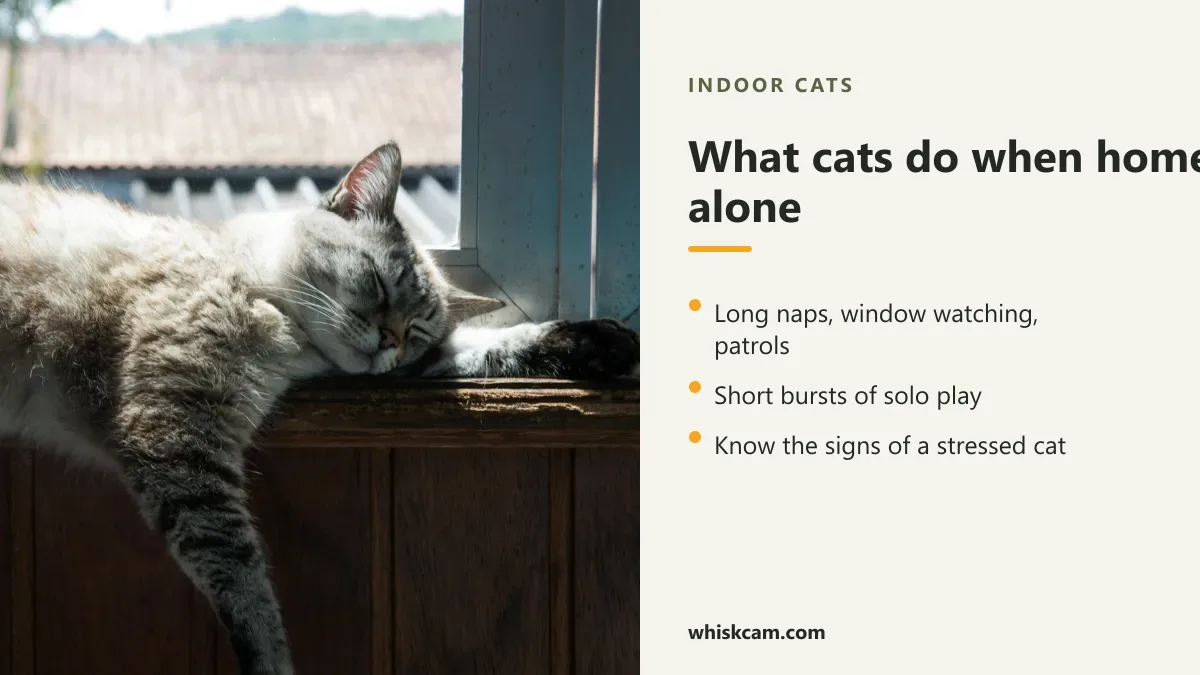
Most cats left alone at home spend much of the time resting in short naps, then fit grooming, eating, looking outside, exploring and brief play between them. Cats are most active around dawn and dusk, so a quiet midday is normal. What varies is how well each cat copes, and that is what is worth watching for.
Most owners never see this part of their cat's day. This guide brings together what veterinary and welfare organisations say about cats left on their own, which behaviours are normal, which ones can point to stress, and what to look for if you record your own cat. Whiskcam Team has not run a behaviour study, so this article contains no activity percentages. Every cat is different, and your own observations will tell you more than an average would.
What Welfare Charities Say About Cats Left Alone
UK charity Cats Protection says most adult cats can occasionally be left alone for up to 12 hours, as long as they have food, fresh water, a clean litter tray, safe toys and places to hide and perch. Kittens should only be left for a few hours. The charity also warns that boredom can lead to overgrooming, overeating or damage to furniture, and that cats closely bonded to their owners may show separation-related problems (Cats Protection: how long can you leave a cat alone?).
Separation-related problems are real but not universal. In a 2020 questionnaire study published in PLOS ONE, owners in one Brazilian city answered questions about 223 cats. Around 13% (30 cats) met at least one of the researchers' criteria for a possible separation-related problem. Those problems were more often reported in homes where the cat had no toys or lived without another animal (de Souza Machado et al., 2020). This was one owner-reported sample, not a figure that applies to every cat, and the authors point out that owners cannot directly observe what their cats do while they are out.
The Five Things Cats Commonly Do When Home Alone
The table below lists common behaviours and what to check in your own recordings. It is a guide to observation, not measured data. Time spent on each one depends on age, health, the layout of your home and whether there are other animals.
| Behaviour | Usually means | Worth noting in footage |
|---|---|---|
| Sleeping or resting | Normal energy conservation between active periods | Where they rest, and whether the spot moves during the day |
| Grooming | Routine coat care, sometimes calming | Long sessions on one area, or new bald patches |
| Window or door watching | Interest in movement outside | Tense posture, tail flicking or a fixed stare at other cats |
| Eating, drinking, litter tray | Basic needs met through the day | Food left untouched until you come home |
| Exploring and play | Curiosity and hunting-type behaviour | Which objects they actually choose to play with |
Sleep Isn't Just Sleep: The Nap Cycle
Cats are crepuscular, meaning they are most active around dawn and dusk. They often spend 12 to 16 hours a day napping, in short bursts spread across the day and night rather than one long sleep (VCA Animal Hospitals). If you are out during the middle of the day, a lot of rest is normal.
A camera that moves with the cat can show where those naps happen. Look for a pattern: does your cat follow the sun across the room, choose a high shelf, or go somewhere enclosed? International Cat Care notes that cats feel safe resting in high places and that hiding places are an essential part of everyday life for a cat (International Cat Care: making your home cat friendly). If recordings show your cat using one spot again and again, keep it available.
Why Window-Watching Deserves a Closer Look
Watching birds, people and traffic can be engaging for an indoor cat, and VCA recommends safe resting places with interesting views as part of indoor enrichment (VCA: enrichment for indoor cats). But a window is not automatically relaxing. International Cat Care explains that large windows can confuse some cats: they can see potential dangers outside without understanding that they are safe indoors. Cats Protection also lists spending a lot of time staring out of the window or cat flap as a possible sign of tension with neighbourhood cats (Cats Protection: cats and fighting).
When you review footage, look at body language at the window. Relaxed watching with soft eyes and a still tail is different from crouching, tail lashing or a long stare at another cat. If it is the second kind, International Cat Care suggests partly blocking the lower part of the glass, for example with frosted film or plants.
The Patrol Route: What to Look for in Your Own Footage
Many owners notice that their cat walks a similar route through the home: checking doors, windows, food and favourite resting places. We cannot tell you how often a typical cat does this, because there is no reliable figure. What you can do is check your own recordings.
- Does the route include places you didn't expect, like a closed door?
- Does it end in a calm nap, or does it repeat without rest?
- Does the pattern change after a new piece of furniture, a visitor or a new cat nearby?
A route that ends with rest is unremarkable. Restless, repeated pacing that does not settle is listed by Cats Protection among the signs of stress, so note it and compare it with other changes (Cats Protection: cat stress).
Solo Play: Make Toys Less Predictable
Many cats ignore expensive toys and pounce on a bottle cap instead. There is a reason for that. International Cat Care notes that most cats prefer toys that resemble hunting. Toys that move unpredictably hold their interest, while motionless toys left lying around soon become predictable and boring. It recommends rotating toys and regularly bringing in new items, such as cardboard boxes or paper bags, for the cat to investigate.
VCA suggests short wand-toy sessions each day and puzzle feeders that deliver part of a meal (VCA). Play with your cat before you leave, then set out a puzzle feeder or a new box. In your footage, note which items your cat actually goes back to.
Signs of a Stressed Cat When You're Not Home
Cats Protection suggests recording your cat while you are out if you are worried about how they cope (Cats Protection: does my cat have separation anxiety?). Signs that the charity associates with stress or separation-related problems include:
- Restlessness. Being unable to settle, pacing or circling.
- Excessive vocalisation. Repeated meowing or crying after you leave. A camera with audio can capture this.
- Changes in appetite. Eating less, or overeating.
- More hiding than usual, or a tense, crouched posture.
- Overgrooming, destructive scratching or toileting outside the litter tray.
Any of these can also have a medical cause. Cats Protection advises seeing your vet first when you notice a change in behaviour (Cats Protection: cat stress). Sitting by the door on its own does not mean your cat has separation anxiety. Cats sit by doors for many reasons, including sounds in the hallway or a warm spot.
What Changes with Two Cats vs One
A second cat is not an automatic fix for loneliness. International Cat Care notes that cats in the same home often form separate social sub-groups, and some cats prefer to live alone when given the choice. Signs of tension can be as subtle as one cat leaving the room when another arrives (International Cat Care: multi-cat households).
If you already have more than one cat, footage can show whether they rest together, groom each other or avoid each other. International Cat Care recommends one of each resource per cat plus one extra, placed in different locations. That includes food, water, litter trays and beds.
Cats With Outdoor Access: A Different Day
If your cat has a cat flap, their time alone will include time outside. That is harder to observe, and a home camera will miss it. GPS research suggests that most pet cats stay surprisingly close to home. We cover that research in where outdoor cats actually go. Before putting any camera on an outdoor cat, read our safety considerations for collar cameras.
How to Record and Read Your Own Cat's Day
You do not need a lab to learn your cat's routine. A simple approach:
- Choose your tool. A fixed pet camera covers one room. A collar camera follows the cat but adds weight to the collar. An activity tracker records movement without showing what the cat is doing.
- Start with short, supervised sessions if you use a collar camera, and stop if your cat freezes, scratches at it or moves differently.
- Record at different times on different days, such as just after you leave and before you return, rather than one long session.
- Keep a simple log of where your cat rests, what they play with, and any of the stress signs above.
Our seven-day cat camera recording plan includes a printable observation template.
Frequently Asked Questions
Do cats get lonely when home alone all day?
Some do. Many adult cats cope with a normal working day if their needs are met, but cats closely bonded to their owners can show separation-related problems. Signs include excessive vocalisation, restlessness, changes in appetite, hiding and toileting outside the tray. Check with your vet if you notice them.
Is it cruel to leave a cat alone for a full workday?
Not usually, if the basics are covered: food, fresh water, a clean litter tray, safe toys, and places to hide and perch. Cats Protection says most adult cats can occasionally be left for up to 12 hours. Kittens, and cats with health conditions, need more frequent care.
Will a cat destroy the house when bored?
It can happen. Cats Protection lists damage to furniture among the possible effects of boredom, and destructive behaviour was among the problems owners most often reported in the 2020 separation-related problems study. Enrichment, play before you leave and puzzle feeders are sensible first steps. Recordings can help you see when it happens.
Do cats really sleep all day?
Cats often nap for 12 to 16 hours a day, but in short bursts spread across the day and night. They are most active around dawn and dusk, so a quiet midday while you are out is normal.
Can I see what my cat does without a camera?
Partially. Activity trackers show when a cat moves but not what it does. Fixed pet cameras show one room. Collar cameras follow the cat but add weight to the collar. Each approach has trade-offs.
The Bottom Line
A cat home alone is usually not bored all day or asleep all day. The day is a series of naps, with grooming, eating, watching and short bursts of exploring in between. Once you know your own cat's pattern, changes like pacing, crying, overgrooming or untouched food are easier to spot, and you can raise them with your vet.
If you want to record what your cat does, the Whiskcam Original is a 24 g collar camera that records 1080P video to a MicroSD card. The card is sold separately. It has no night vision, and its continuous battery runtime has not been independently verified, so plan short sessions. Whiskcam publishes this article and sells that camera.
Sources
- Cats Protection: How long can you leave a cat alone?
- Cats Protection: Does my cat have separation anxiety?
- Cats Protection: Cat stress
- Cats Protection: Cats and fighting
- International Cat Care: Making your home cat friendly
- International Cat Care: Multi-cat households
- VCA Animal Hospitals: True or false, cats are nocturnal
- VCA Animal Hospitals: Enrichment for indoor cats
- de Souza Machado D. et al. (2020). Identification of separation-related problems in domestic cats: A questionnaire survey. PLOS ONE 15(4): e0230999