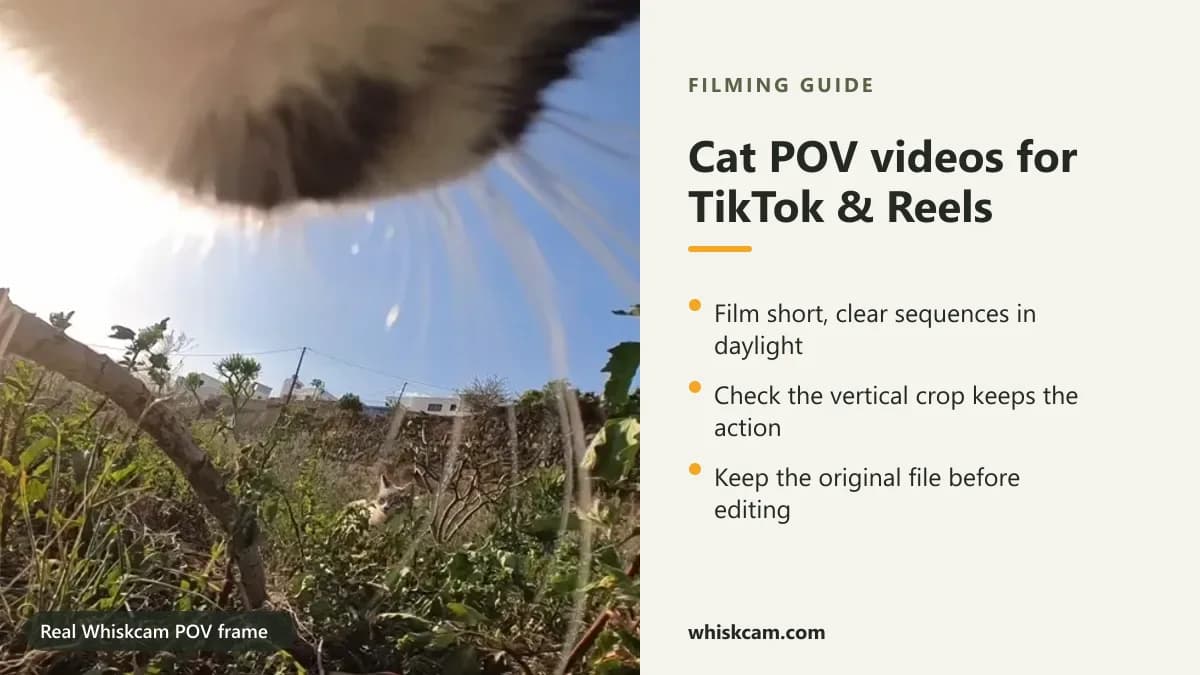
Successful cat POV videos on TikTok tend to share four things: a clear story in a few seconds, footage captured when the cat is active, a hook in the first second, and a real discovery or a cute moment. Hardware matters less than most people think. Choosing the right moment and editing it well do most of the work. Nothing guarantees views.
This guide is for people who have seen the big cat POV accounts and want to understand how the format works. It covers timing, editing and a realistic plan. It is not a promise of going viral overnight, and the suggestions below are editorial advice, not results from a Whiskcam study.
What's Actually Trending in 2026
Cat POV is no longer a niche. Several accounts have built large audiences around footage from a camera on a cat's collar or harness. Their view counts change constantly and are best checked on the accounts themselves. Two broad styles have emerged: indoor clips built around the home, and outdoor "day in the life" clips that follow a cat around the neighbourhood.
Common hashtags include #catcam, #catpov, #cattok and #dayinthelife. Hashtags help describe a video, but there is no proven combination that guarantees reach. Treat them as labels, not a growth strategy.
Two formats are common: the short clip with a clean story (leave the house, discover something, come back) and the longer compilation stitched together from a day of footage. TikTok does not publish a precise ranking formula, so be wary of anyone who claims to know exactly what the algorithm rewards in a given month.
The Hardware You Actually Need
There are roughly three tiers, and many people overspend on their first purchase. The entry level is a small collar camera, such as the Whiskcam Original or an equivalent. Whiskcam lists a camera weight of 24 g and 1080P recording, and needs no app. For a first account, 1080P is enough for vertical social video. Whiskcam publishes this guide and sells that camera.
The mid tier is a small action camera, such as the Insta360 GO range. Action cameras can offer better stabilisation and higher resolution, but they are heavier and cost more. See our Whiskcam vs Insta360 GO 3 comparison for the listed specifications.
The pro tier is a multi-camera setup with desktop editing software such as Premiere or DaVinci Resolve. You don't need it to start.
Whatever you choose, check the total weight on the collar, use a quick-release collar and start with short, supervised sessions. Get the content right first and upgrade the hardware later. Expensive footage of a cat sleeping is still footage of a cat sleeping.
The Golden Hour (And Why Most People Film at the Wrong Time)
Cats are crepuscular: they are most active around dawn and dusk. They often nap for 12 to 16 hours a day in short bursts (VCA Animal Hospitals). If you film at midday you will often get a cat who sleeps, grooms, then sleeps again. If you film around dusk, the same cat is more likely to be exploring, climbing and reacting to things.
For indoor cats, active periods are often tied to feeding times, so try recording around meals. Outdoor cats are often more active around dawn and dusk. Note when your own cat is most active and plan short sessions around those times.
Expect to record a lot more than you post. Most raw footage of a cat is walking, resting and grooming. A few good seconds can come from a long stretch of uneventful recording, and at the wrong time of day you may get nothing usable. That is usually a timing problem, not a faulty camera.
The 7-Second Story Arc
A simple structure for short clips: Hook (0-1s), Setup (1-4s), Payoff (4-7s). It isn't a rule, but it is a useful test.
A concrete example. Hook: the cat jumps off the couch and the camera swings fast. Movement in the first frame can stop someone scrolling. Setup: the cat walks through the kitchen and passes an open fridge. Payoff: the cat reaches for something on the lower shelf. Seven seconds. Clear story. Rewatchable.
A weak example: 15 seconds of a cat walking down a hallway without finding anything. No hook, no setup, no payoff.
The test is simple. If you can sum up the video in five words, such as "cat discovers X," "cat confronts Y" or "cat escapes Z," you have a video. If you can't, you have footage. Most editing work is finding the few clips that pass this test.
Longer formats can work too, but they need a reason to keep people watching.
What to Actually Film
Five categories tend to make good POV material:
"First time" moments. First outdoor recording. First time meeting another cat. First snow. First encounter with a bird. Novelty gives a clip a natural story.
Discovery moments. The cat finds a hidden spot, meets a delivery person, or wanders into a neighbour's garden. The viewer discovers it at the same moment as the cat, which is the emotional hook of the POV format.
The POV itself. A jump onto a high shelf looks dramatic from a collar camera. Passing under a low bench looks like a cinematic crawl shot. In these clips the point of view is the story.
Everyday moments made strange. Grooming seen from ground level becomes oddly hypnotic. Jumping onto a bed becomes a first-person launch sequence. The routine is familiar, and the POV makes it new.
Encounters. Another cat on the wall, a cautious dog, a squirrel at eye level. Visual tension holds attention. Never set up or encourage confrontations, though. If your cat looks stressed, stop recording and let them settle.
What to avoid: long stretches of walking with no destination, very dark clips (Whiskcam has no night vision, and low light looks grainy on most small cameras), and long stretches of sleeping.
Editing That Converts Views to Follows
Length first. Very short clips suit single moments. A 30 to 60 second cut suits a small story, and longer compilations suit a full outing. Try different lengths and compare your own analytics rather than relying on a supposed universal sweet spot.
Add on-screen captions. Many people scroll with the sound off, and text helps the story land without audio.
Trending sounds can help a clip fit what people are already watching. Check that a sound is licensed for your use. Original audio works well once viewers come back for your cat specifically.
Cut tightly. POV footage is shaky, and lingering on one moment without anything new happening quickly loses viewers.
End the video by either resolving the story clearly or creating a loop so the viewer doesn't notice it restarting. Cutting off in the middle of an action, with no resolution or loop, is a common mistake.
Safety and Ethics Before You Post
Use a properly fitted quick-release (breakaway) collar for any cat wearing a camera, especially outdoors. Our guide on whether cat collar cameras are safe covers fit, weight and supervised trials. A camera adds weight and the risk of snagging, so start with short sessions you can watch.
Privacy matters too. If your cat wanders into a neighbour's property and the camera captures the inside of their home, don't post that footage without their permission. Avoid showing faces, house numbers and number plates.
Rules on audio recording are often stricter than for video, and they vary by country and region. If you're unsure, remove the original audio and use a licensed sound instead.
Finally, some cats won't accept a camera. They scratch at it, freeze or change how they move. If your cat is one of them, accept it and stop. Forcing a reluctant cat is bad for the cat, and the discomfort shows on camera.
How Long Until You Hit Viral?
The honest answer: nobody can tell you. Some creators post for months before a clip takes off, some never get a big hit, and a few get one early. Treat any specific number of videos or days as a guess.
What you can control is consistency. Post regularly enough to learn what your audience responds to, but not so often that quality drops or your cat is wearing a camera more than is comfortable.
If you've posted three clips with a few hundred views each and decided the format doesn't work, you have very little data. Keep going long enough to compare different hooks, lengths and times of day.
A Realistic 30-Day Plan
A schedule for someone starting from zero. Adjust it to your cat's comfort, which always comes before content.
Days 1-3: Setup. Fit the collar and camera and let your cat get used to it in short, supervised sessions. Don't try to produce anything yet. Stop if your cat seems uncomfortable.
Days 4-7: Short sessions at active times. Record one short session a day around the times your cat is most active. Check the battery and storage before each session, because Whiskcam's continuous runtime has not been independently verified. The goal is a library of footage, not finished videos.
Days 8-10: Review and tag. Skim the footage at higher speed. Pick out the moments that pass the five-word test and archive the rest.
Days 11-20: Post regularly. Vary the format, with some very short clips and some longer stories. Add captions and test both trending sounds and original audio.
Days 21-30: Analyse and double down. Look at which videos did clearly better than the rest. Whatever they share, whether that is the hook, the length or the time of day you filmed, is the starting point for next month.
Frequently Asked Questions
Can any cat be a viral TikTok cat?
Not necessarily. Temperament matters more than looks. A calm, curious cat who accepts a collar and explores will give you more to work with than a cat who is anxious about it. Some cats never accept a camera, and many will mostly record sleeping. If your cat dislikes the camera, don't force it.
Do I need 4K to go viral?
No. 1080P is enough for vertical social video, and platforms compress uploads anyway. What makes a clip work is the moment you choose, the pace of the edit and the sound. Higher resolution gives you more room to crop, but it is not what makes a video spread.
What camera do the big cat POV accounts use?
It varies, and setups change over time. Some creators mention their gear in their own videos or profiles. Check those directly instead of relying on second-hand lists. Better gear usually follows a format that already works. It doesn't create one.
How many views is considered viral for a cat video?
There is no official threshold. A practical definition is a video that reaches far beyond your usual audience, measured against your own average. For a new account that might be a few thousand views. For an established one it could be many times more.
The Bottom Line
Your cat is already unique, and the camera is just a way to show it. Hardware is a tool, not a shortcut. Many creators start with simple gear, small audiences and a lot of trial and error. If you want a structured way to start, follow our seven-day cat camera recording plan. If you're choosing a camera, the Whiskcam Original is a 24 g, 1080P collar camera that needs no app. A MicroSD card is sold separately, and it has no night vision. Whiskcam publishes this guide and sells that camera.