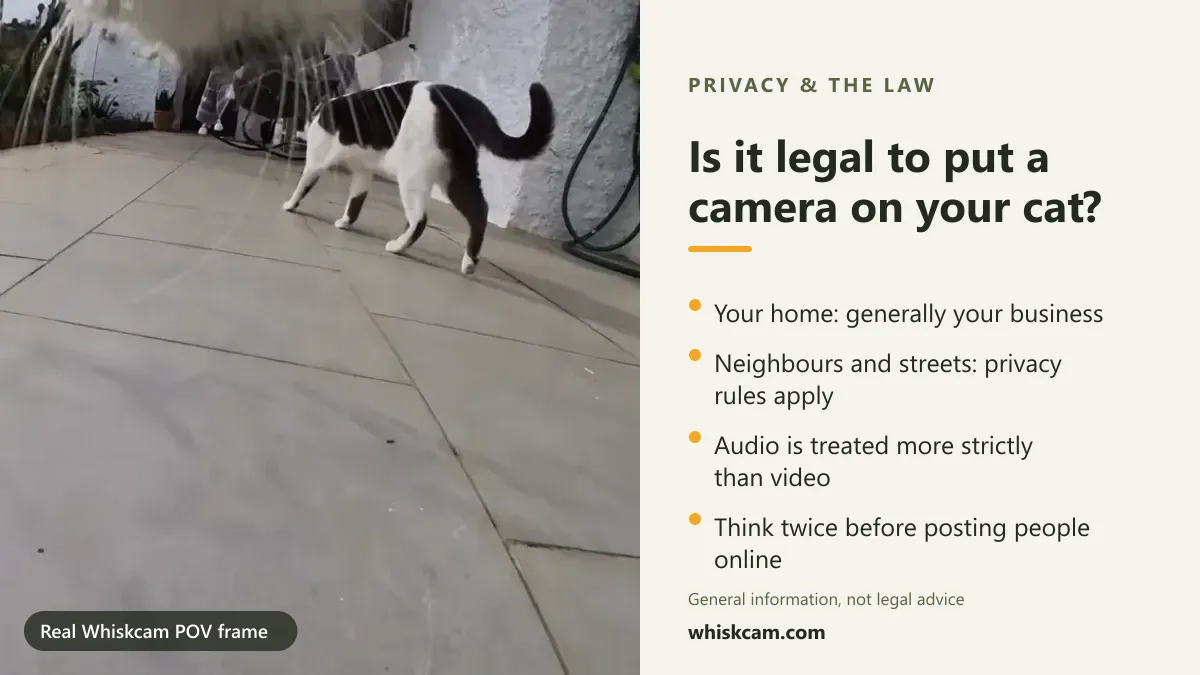
Putting a camera on your own cat is generally not illegal in itself. The legal questions start with what the camera captures once your cat leaves your home: neighbours, their gardens, people in the street and, above all, their conversations. Here is what UK, EU and US rules say, and the simple habits that keep cat POV footage on the right side of them.
Not legal advice. This guide summarises official sources checked on October 2, 2026. Rules vary by country and state, and a lawyer or your national data protection authority can advise on your situation. Whiskcam sells a cat collar camera.
Is it legal to put a camera on your cat? The short answer
- Inside your own home: recording your cat for your own viewing is usually a private, household matter.
- Neighbours' property and public places: once a camera captures other people, privacy and data protection rules can apply, even if the camera is on a pet.
- Sound: recording conversations is treated more strictly than video in the UK, the EU and the US.
- Sharing: posting footage of identifiable people online is where most problems start.
A cat collar camera is unusual because nobody points it. Your cat decides where it goes, which is exactly why you should review footage before keeping or sharing it.
UK: what the ICO says about home cameras
UK GDPR does not apply to processing “by an individual in the course of a purely personal or household activity” (UK GDPR, Article 2). The Information Commissioner's Office explains where that stops for home cameras: if a camera captures someone else's property, a public area or a communal space, data protection law applies (ICO: home CCTV systems). The same page notes that cameras can capture images and voices of other people, which is their personal information.
The ICO has no guidance written specifically for pet-worn cameras. Our reading is that a camera on an outdoor cat that wanders into gardens and streets is likely to capture exactly what the ICO describes. In practice that means having a clear reason to keep footage, not keeping more than you need, deleting it regularly and responding if someone asks about recordings of them.
On sound, the ICO's guidance for organisations states that audio recording, particularly continuous recording, is more privacy intrusive than purely visual recording (ICO: surveillance and data protection). A 2021 county court case, Fairhurst v Woodard, reached a similar view about a neighbour's doorbell and cameras: the court treated the audio as more problematic than the video. It is a county court decision, so it is persuasive rather than binding.
EU: the household exemption is narrow
GDPR has the same exemption for purely personal or household activity. The Court of Justice of the EU held in Ryneš (C-212/13) that a home camera which also monitors a public space is not purely personal or household processing (judgment C-212/13).
The European Data Protection Board's guidelines on video devices say the exemption must be read narrowly. A camera covering your own garden is covered provided it does not extend, even partially, to a public space or neighbouring property. The same guidelines give examples that do fall under the exemption, such as action-camera footage kept for personal entertainment or holiday videos shown to friends and family (EDPB Guidelines 3/2019).
Cat POV clips you watch at home sit closest to those examples. Footage of neighbours that you keep or distribute does not. National criminal laws on secret recording, for example in France and Germany, apply on top of GDPR, so check local rules if you record audio.
US: video is less restricted than audio
US law varies by state, but two principles appear consistently. Video of places where people have no reasonable expectation of privacy is generally less restricted than sound. Recording private spaces such as bathrooms or bedrooms can be a crime under state voyeurism laws; in California, for example, viewing such areas with a camera with intent to invade privacy is an offence (California Penal Code §647).
Audio is governed by the federal Wiretap Act, which prohibits intercepting oral communications unless a party to the conversation consents (18 U.S.C. §2511). It protects conversations where people expect privacy (18 U.S.C. §2510). A cat owner who is not present is not a party to a neighbour's conversation, so one-party consent does not help. Several states, including California, Florida, Illinois, Maryland, Massachusetts, Montana, New Hampshire, Pennsylvania and Washington, require consent from every party to a confidential conversation, according to the Reporters Committee for Freedom of the Press (RCFP recording guide; see also California Penal Code §632).
Posting cat camera footage online
Sharing is where household use usually ends. The EU Court of Justice has held that publishing personal data on the internet to an indefinite number of people is not a household activity, and that posting a video on YouTube without restricting access can fall under GDPR (Buivids, C-345/17). The EDPB treats number plates and other details that identify passers-by as personal data.
Before posting a cat POV video, watch it to the end. Cut or blur faces, number plates and house numbers, and remove sound that includes other people's voices. Clips of your cat, your home and empty landscapes rarely raise these issues.
Your cat's welfare is part of the legal picture
We found no law that bans or specifically regulates cat collar cameras. In England and Wales, the Animal Welfare Act 2006 requires owners to take reasonable steps to protect a pet from pain, injury and disease and to let it behave normally (Animal Welfare Act 2006, section 9). The government's code of practice for cats asks owners to make sure collars fit properly with a quick-release mechanism (Defra cat welfare code).
A camera that changes how your cat moves, or that blocks the collar release, is a welfare problem before it is a legal one. Our cat collar camera safety guide covers fit, total load and when to stop a trial.
A practical checklist for cat camera owners
- Record mainly at home and in your own garden at first.
- Check whether your camera records sound. Whiskcam records audio with its video, so mute or cut sound that captures other people's conversations before keeping or sharing a clip.
- Review footage soon after each session and delete clips of other people you do not need.
- Blur or cut faces, number plates and house numbers before sharing.
- If a neighbour objects, stop recording near their property and delete what you hold of them.
- Use a properly fitted quick-release collar and keep sessions short and supervised.
For sharing ideas that keep the focus on your cat, see our cat POV filming guide. To understand where your cat actually goes before recording outdoors, read where outdoor cats go and our cat collar camera comparison.
Frequently asked questions
Is it legal to put a camera on my cat?
In general, owning and attaching a small camera to your own cat is not illegal in itself. What the camera records matters more: footage of your own home is usually a private matter, but recording neighbours, their gardens or people in public can bring in privacy and data protection rules, and recording conversations can engage audio-recording laws. This is general information, not legal advice.
Can my cat camera record my neighbours?
In the UK and EU, the household exemption from data protection law is read narrowly. The ICO says that if home CCTV captures someone else's property or a public area, data protection law applies, and the EU Court of Justice held in Ryneš (C-212/13) that a home camera covering public space is not purely household activity. Avoid keeping or sharing footage that identifies neighbours.
Is recording sound with a pet camera treated differently?
Yes. Regulators and courts treat audio as more intrusive than video. In the US, the federal Wiretap Act and state laws restrict recording private conversations without consent, and some states require every party's consent. An owner who is not present is not a party to a neighbour's conversation. Whiskcam records sound with its video, so mute or cut audio that captures other people before keeping or sharing a clip.
Can I post my cat camera footage online?
Footage that only shows your cat and your own home is generally fine to share. In the EU, publishing footage of identifiable people to an unrestricted audience falls outside the household exemption, according to the EU Court of Justice. Blur or cut faces and number plates of other people before posting.
Is there a law about putting devices on cats?
We found no law specifically about cat collar cameras. In England and Wales, the Animal Welfare Act 2006 requires owners to take reasonable steps to protect a pet from injury and allow normal behaviour, and the government's cat welfare code says collars should fit properly with a quick-release mechanism.
Spotted an error or a rule that has changed? Write to support@whiskcam.com.