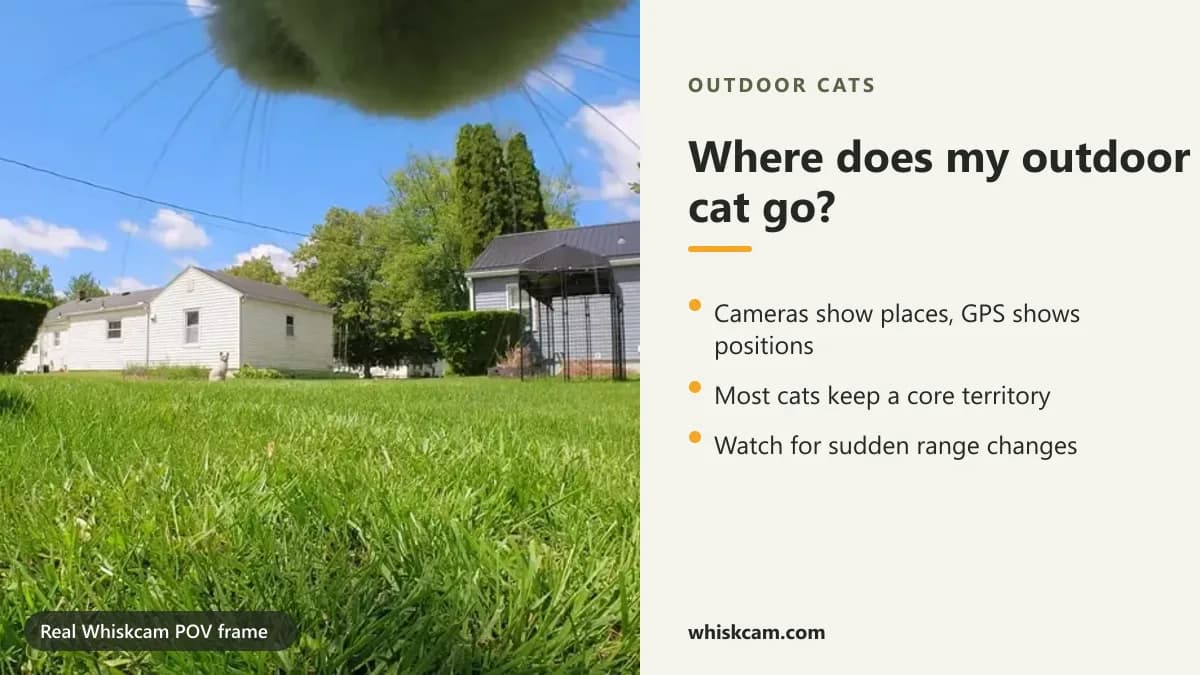
Most pet cats with outdoor access stay much closer to home than their owners imagine. In the largest GPS study of pet cats, 925 cats in six countries had an average home range of about 3.6 hectares, and most spent their time within roughly 100 m of home. A few cats do roam widely, but they are the exception.
When people imagine their outdoor cat's day, they picture long expeditions. GPS research mostly says otherwise. Below is what the published tracking studies found, what a collar camera can add, and how to work out your own cat's territory. We cite each figure to its study. Whiskcam Team has not run its own tracking or camera study.
The Surprising Science of Cat Range
Two GPS studies of owned cats with outdoor access give a consistent picture.
- The international Cat Tracker study (Kays et al., 2020, Animal Conservation). Researchers worked with citizen scientists to track 925 pet cats from six countries. The largest groups came from Australia, New Zealand, the US and the UK. Excluding three outliers, the average home range of the remaining 875 cats was 3.6 ha (±5.6 ha). The authors conclude that the cats' impact was concentrated within about 100 m of their homes (paper; NC State University summary). According to National Geographic's report on the project, more than half the cats stayed within about 2.5 acres (roughly 1 ha), and 7% covered more than 25 acres (National Geographic).
- A Danish GPS study (Jensen et al., 2022, Animals). Researchers tracked 97 cats for about seven days each. The median cat spent about 5 hours a day away from home, moved about 2.4 km a day, and had a home range of about 5 ha. Cats older than seven roamed less, intact males had much larger ranges than neutered males, and cats with access to nature areas ranged further (Jensen et al., 2022).
The factors line up across both studies. In the Cat Tracker data, older cats roamed less: no cat over seven years old had a home range larger than 0.25 km². Rural cats had ranges about 1.6 times larger than urban cats, and males and unneutered cats moved further. Only 10 of the tracked cats were unneutered, however, so the authors caution that their sample was small for comparing intact and neutered cats.
Daily distance and home range are different measures. A cat can walk a couple of kilometres in a day, as in the Danish study, while still circling inside a small area of nearby gardens.
A methodological note: GPS collars have accuracy limits, tracking periods were short (often about a week), and the cats came from owners willing to volunteer. Your cat may differ from the averages. The consistency between independent studies is what makes the overall picture credible.
The Core Territory Pattern
A useful way to think about your own cat's territory is as layers around your home. This is an observation framework, not a measured breakdown, so we don't assign time percentages to each layer.
- Home base: your garden, porch or yard and the area immediately around the house.
- Neighbouring gardens: fence tops, hedges, shared paths and the yards next door. The Cat Tracker team described the typical range as usually covering a few neighbours' yards (NC State). Other cats often use these areas too.
- Occasional destinations: a particular shed, a field edge or a quiet corner of the wider neighbourhood that the cat visits now and then.
- Rare long trips: uncommon. In the Cat Tracker study, only three of 925 cats ranged over more than 1 km².
What Cameras Show That GPS Can't
GPS tells you a cat went somewhere. It doesn't tell you why. A dot on a map that sits in a neighbour's garage for 20 minutes is interesting but not very useful on its own. A collar camera can supply the context: what the cat was looking at, what it was doing and who it met.
Questions a camera can help answer, which a GPS track usually can't:
- Is the cat resting somewhere warm, or hiding from something?
- Is a repeated route following a scent trail, another cat or a food source?
- Is a long stop at a neighbour's house about food, shelter or company?
The trade-off: a camera does not record coordinates, adds weight to the collar, and only shows what is in front of the cat. A GPS tracker is the better tool if location is what you need.
The Time Patterns of an Outdoor Cat's Day
Cats are crepuscular, which means they are most active around dawn and dusk. They often nap for 12 to 16 hours a day in short bursts spread across the day and night (VCA Animal Hospitals). For most outdoor cats, that means:
- Around dawn: a likely activity peak, with patrols, hunting-type behaviour and encounters with other cats.
- Middle of the day: often quieter, with resting in a shaded spot or a sunny patch.
- Around dusk: a second likely peak.
- Night: varies a lot between cats, and depends on whether your cat is kept in overnight.
The tracking studies above measured range and distance, not exact hours of activity. Your own cat's timing may differ, so record at different times of day to see when your cat is actually active. Neighbourhood cats often use the same areas at different times. Cats Protection suggests that owners of cats who clash agree to let them out at different times (Cats Protection: cats and fighting).
The Secondary Home Phenomenon
Some outdoor cats have a "second address": a neighbour who feeds them, a shed or greenhouse that is reliably open, or a family who thinks of the cat as partly theirs. There is no reliable figure for how common this is. Given how small most cats' ranges are, it is usually somewhere very close to home.
The RSPCA notes that many cats will take an extra meal even when they are well fed, and that being fed elsewhere can mean a cat comes home less often and gains weight (RSPCA). A polite conversation usually sorts it out. Make sure the neighbour knows the cat has a home, and explain any diet or allergy concerns. For more owner-reported examples, see five weird things people discovered with a cat collar camera.
When to Worry About Range Changes
Most range variation is normal. Cats shift routes when new cats move into the area, with the seasons and as they age. A few patterns are worth paying attention to.
- A sudden, large expansion of range: possibly a conflict with a new cat nearby, or a change in where food is available.
- Missing for longer than usual: act early. Cats Protection advises checking sheds, garages and cupboards, asking neighbours to check theirs, and contacting your microchip database, local vets and shelters (Cats Protection: lost a cat).
- Coming home wet, shivering, injured or disoriented: contact your vet.
- Weight loss together with a wider range: worth a vet check. Food sources may have changed, but weight loss can also be a sign of illness.
- Sudden reluctance to go out, or more hiding: possibly a frightening encounter or a conflict with another cat.
How to Map Your Cat's Territory
If you're curious about your own cat's range, you have a few options depending on how much precision you want.
- GPS tracker (Tractive, Weenect and similar): reports location to a phone app and usually needs a subscription. Check the manufacturer's listed weight and add it to the collar load.
- Collar camera over a few weeks: shows behaviour and recognisable landmarks but not precise coordinates. Best for understanding what the cat does rather than exactly where.
- Both, at different times: GPS for the map, camera for the context. Weigh the total load before adding devices to a collar.
- Neighbourhood observation: ask neighbours, and check common cat routes like fence tops and hedges.
For a zero-cost starting point, draw a circle of about 100 m around your home on a map. Based on the Cat Tracker research, that is where many pet cats spend much of their time outdoors. Your cat may differ. For a detailed comparison of tracking options, see our deep dive on cat collar cameras vs GPS trackers.
A Few Famous Cat Ranges
Individual cats from the Cat Tracker study show how wide the spread can be:
- Typical ranges: the paper shows example cats with home ranges of 1.6 ha (Katniss Everdeen, USA), 3.3 ha (Theo, New Zealand) and 4.3 ha (Bugsy, Australia) (Kays et al., 2020).
- Larger than average: Worf, a UK cat, had a home range of 16.2 ha.
- Max, a neutered tomcat in south-west England, walked about 1.7 km along a road between two villages twice during his tracking period (National Geographic; Kays et al.).
- Penny, a young female from the suburbs of Wellington, New Zealand, roamed the hills behind her house and covered more than three square miles. She was the study's widest-ranging cat (National Geographic).
The takeaway: outliers exist, and some cats really do roam. The typical cat in these studies, though, stayed within a few gardens of home.
Frequently Asked Questions
How far do outdoor cats typically roam?
Less than most owners think. In the Cat Tracker study of 925 pet cats, the average home range was about 3.6 ha, and most cats stayed within roughly 100 m of home. Only three ranged over more than 1 km². Older cats roamed less. Males, unneutered cats and rural cats tended to range further.
Where does my cat go at night?
It depends on the cat. Cats are most active around dawn and dusk, and many outdoor cats stay within a few gardens of home. If your cat is out overnight, the best way to find out is to track or record them, and there is no reliable universal pattern. Keeping cats in at night is a choice many owners make for safety.
Should I keep my cat indoors to limit roaming?
That's a personal decision with legitimate arguments on both sides. Outdoor access brings risks from traffic, fights and getting lost, and outdoor cats affect local wildlife. It also gives cats stimulation that is hard to replicate indoors. A catio, harness walks or supervised garden time can be a middle ground.
Can I know where my cat goes without a GPS?
Partially, yes. A collar camera gives you behaviour and recognisable landmarks, even without exact coordinates. Combined with asking neighbours and checking common cat routes like fence tops and hedges, you can often piece together the rough territory over a few weeks.
The Bottom Line
Your outdoor cat probably roams less than you think. Large GPS studies agree on that. The more interesting question isn't whether your cat goes far. It's what they do in the small area they actually use.
For stories owners commonly report once they start recording, this piece covers five common discoveries. If you want to record your own cat's outdoor routine, the Whiskcam Original is a 24 g collar camera that records 1080P video to a MicroSD card. The card is sold separately. It has no night vision or GPS, and its continuous battery runtime has not been independently verified, so plan short sessions around dawn or dusk. Read our collar camera safety guide first. Whiskcam publishes this article and sells that camera.
Sources
- Kays R. et al. (2020). The small home ranges and large local ecological impacts of pet cats. Animal Conservation 23: 516–523
- NC State University News: Keeping cats indoors could blunt adverse effects to wildlife (2020)
- National Geographic: 'Cat Tracker' study shows where pet cats go when they're outside
- Jensen H.A. et al. (2022). Movement patterns of roaming companion cats in Denmark: a study based on GPS tracking. Animals 12(14): 1748
- VCA Animal Hospitals: True or false, cats are nocturnal
- RSPCA: Why you shouldn't feed other people's pets
- Cats Protection: Cats and fighting
- Cats Protection: Lost a cat