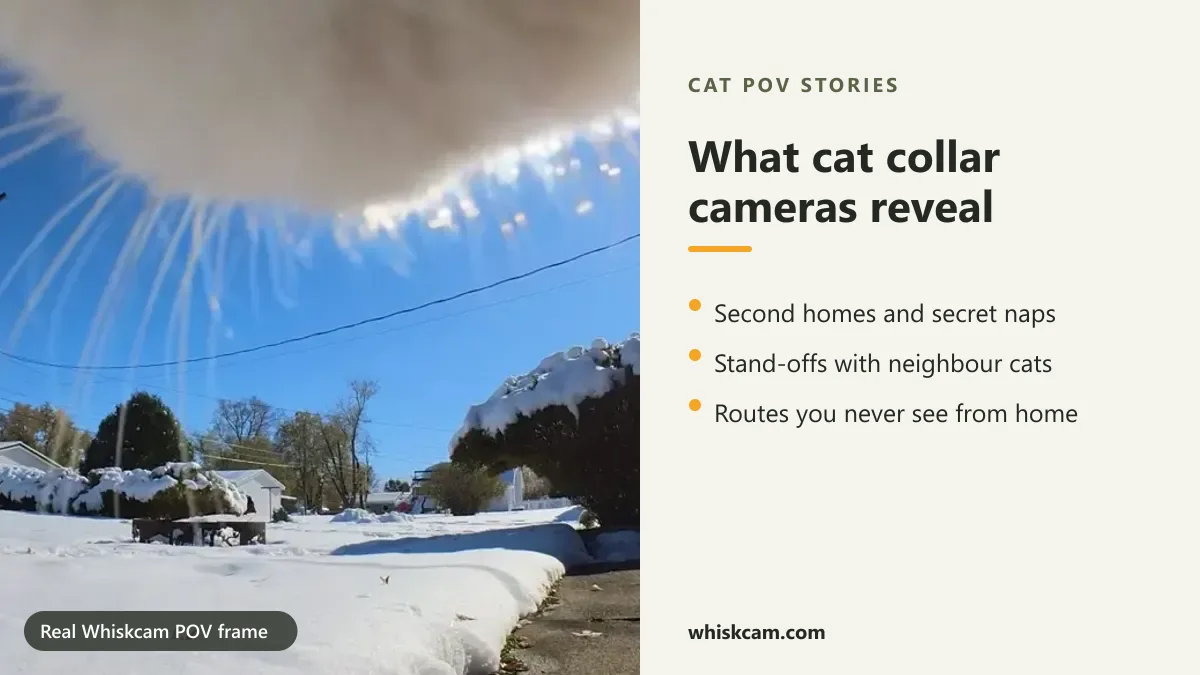
Owners who put a camera on their cat often find something they didn't expect: a neighbour who feeds the cat, a nap spot nobody knew about, a regular meeting with another cat, or a fear of something harmless. Here are five commonly reported discoveries and what the behaviour research says about why they happen.
Where These Stories Come From
These are patterns that cat owners commonly describe when they share collar camera clips online and in cat communities. They are not results from Whiskcam testing, and they are not individual case reports we have verified. We do not include names, ages or exact figures for that reason. Nobody has published reliable data on how often each pattern happens, so treat them as things worth looking out for, not predictions. Where there is research or welfare guidance on the underlying behaviour, we link to it.
1. The Second Home (or: "Your Cat Has a Roommate You've Never Met")
The classic discovery: a cat with outdoor access that seems to have a dull routine turns out to visit the same neighbour's garden, garage or kitchen regularly. Sometimes the neighbour has been leaving out food or a blanket. Sometimes they have assumed the cat is a stray.
That fits what we know about where pet cats go. The international Cat Tracker study followed 925 pet cats with GPS. It found that most stayed within about 100 m of home, an area that usually covers a few neighbouring gardens (NC State University summary; Kays et al., 2020, Animal Conservation). If one of those gardens offers food, warmth or a quiet place to sleep, it can easily become part of the routine.
The RSPCA notes that many cats will take an extra meal even when they are well fed at home. Being fed elsewhere can cause weight gain or allergic reactions, and can mean the cat comes home less often (RSPCA: why you shouldn't feed other people's pets). It does not mean your cat prefers the other person. It is usually a sign that the cat has found a reliable resource nearby.
2. The Hidden Nap Location Nobody Checks
Owners often think they know where their cat sleeps: the armchair, the bed, the sunny windowsill. Footage sometimes shows another spot entirely, such as behind an appliance, on top of a wardrobe, or inside a cupboard or laundry basket. The spot may also change with the seasons.
This is less strange than it looks. International Cat Care explains that cats feel safe resting in high places, and that hiding places are an essential part of everyday life for a cat (International Cat Care: making your home cat friendly). An enclosed, warm, quiet corner meets those needs. Without footage, owners rarely see how long a cat spends in a spot like that.
The practical check is safety. A spot next to a running appliance, a heater or anything that could trap or pinch a cat should be blocked off, and you can offer a safer enclosed bed nearby.
3. The Staring Session With Another Cat
Another commonly shared clip: two neighbourhood cats on a garden wall or fence, sitting a short distance apart, watching each other for a long time, then one walks away. No fight, no play.
Cats Protection notes that cats prefer to avoid conflict and that fighting is a last resort. It suggests that owners of cats who clash arrange to let them out at different times (Cats Protection: cats and fighting). Cats in the same neighbourhood often use shared routes at different times. A calm, distant stand-off can be part of how they manage that.
Not every stare is friendly, though. Cats Protection also lists long periods of staring out of a window or cat flap as a possible sign of tension with neighbourhood cats. In footage, look at body language: flattened ears, a lashing tail, crouching or growling suggest a standoff, not a peaceful truce.
4. The Food-Stealing Expedition
A related discovery: a cat that is gaining weight despite unchanged portions turns out to be eating elsewhere. The cat might be getting treats at one back door, or finishing another cat's bowl through a neighbour's cat flap.
The RSPCA describes exactly this problem. Owners have no control over what or how much their cat is fed elsewhere. It suggests a snap-safe, quick-release "don't feed me" collar for cats on a diet or with allergies (RSPCA). If your cat's weight is changing for no obvious reason, talk to your vet before assuming it is a neighbour. Weight changes can also have medical causes.
5. The Thing They're Actually Afraid Of
Owners often have a fixed idea of what scares their cat: the vacuum cleaner, the doorbell. Footage sometimes shows something different. A cat may calmly ignore the vacuum but take a wide detour around an ordinary object, like a box, a bag or a new piece of furniture, and back away from it with flattened ears.
We can't know why a particular cat fears a particular object, but cats can link everyday objects with earlier unpleasant experiences. Cats Protection lists hiding, a tense crouched posture, flattened ears and wide pupils among signs of stress, and says cats are good at hiding how they feel (Cats Protection: cat stress). A camera can catch reactions that happen when nobody is in the room.
Why Collar Cameras Reveal What Regular Cameras Don't
A fixed home camera only covers what is in its frame. Once the cat leaves the room, the recording stops being useful. It cannot follow the cat to the garage next door, onto the garden wall or into the cupboard.
A collar camera roughly follows what is in front of the cat's head. There are limits. It adds weight to the collar. The wide-angle lens can distort distances. Clips are often shaky. Low-light footage depends on the camera: Whiskcam has no night vision, while some other collar cameras list infrared recording. GPS is better for location. For more on indoor routines, see our guide to what cats do when alone at home.
What to Do With What You Find
Most discoveries like these are harmless. A few practical notes:
- Second feeder situations: Start with a friendly conversation. Make sure the neighbour knows the cat has a home, and explain any diet or allergy concerns. A quick-release "don't feed me" collar is another option the RSPCA mentions.
- Hidden nap spots: If the spot is safe, leave it. If it is near a running appliance, a heat source or anything that could trap or pinch, block it and offer a safer enclosed bed nearby.
- Unexpected fears: Don't force your cat to approach the object. Move it somewhere neutral, give your cat space and a way to avoid it, and speak to your vet or a qualified behaviourist if the fear affects daily life.
Frequently Asked Questions
Do all outdoor cats have a second home?
No, and there is no reliable figure for how many do. GPS research shows most pet cats stay within about 100 m of home, so neighbouring gardens are often part of their range. A cat that is regularly fed or sheltered by a neighbour is a common story, but how often it happens is unknown.
Is it ethical to film a cat going into a neighbor's property?
Rules on recording, especially audio, differ by country and region, so check what applies where you live. Out of respect, tell a neighbour if your cat regularly goes into their home or enclosed garden. Don't publish footage of the inside of someone else's home without their permission.
How often should I review footage to spot patterns?
There is no set rule. Many owners find a weekly review easier than checking every clip daily. Cats tend to follow routines, so writing down rest spots, routes and encounters in a simple log makes repeated patterns easier to see.
Can short recording sessions reveal cat behavior patterns?
Yes, if you repeat them. One short clip shows a moment, not a pattern. Several short sessions at similar times of day, over a few weeks, will show what repeats. Short sessions also let you check that your cat tolerates the collar and camera.
The Bottom Line
Collar cameras don't change your cat. They make you a more attentive observer of a small animal whose life is more social and more routine-driven than most people assume. The discoveries are rarely dramatic. They are small, specific and often easy to act on.
If you want to record your own cat's day, the Whiskcam Original is a 24 g collar camera that records 1080P video to a MicroSD card. The card is sold separately. It has no night vision, and its continuous battery runtime has not been independently verified, so start with short, supervised sessions. Whiskcam publishes this article and sells that camera.
Sources
- Kays R. et al. (2020). The small home ranges and large local ecological impacts of pet cats. Animal Conservation 23: 516–523
- NC State University News: Keeping cats indoors could blunt adverse effects to wildlife (2020)
- RSPCA: Why you shouldn't feed other people's pets
- Cats Protection: Cats and fighting
- Cats Protection: Cat stress
- International Cat Care: Making your home cat friendly