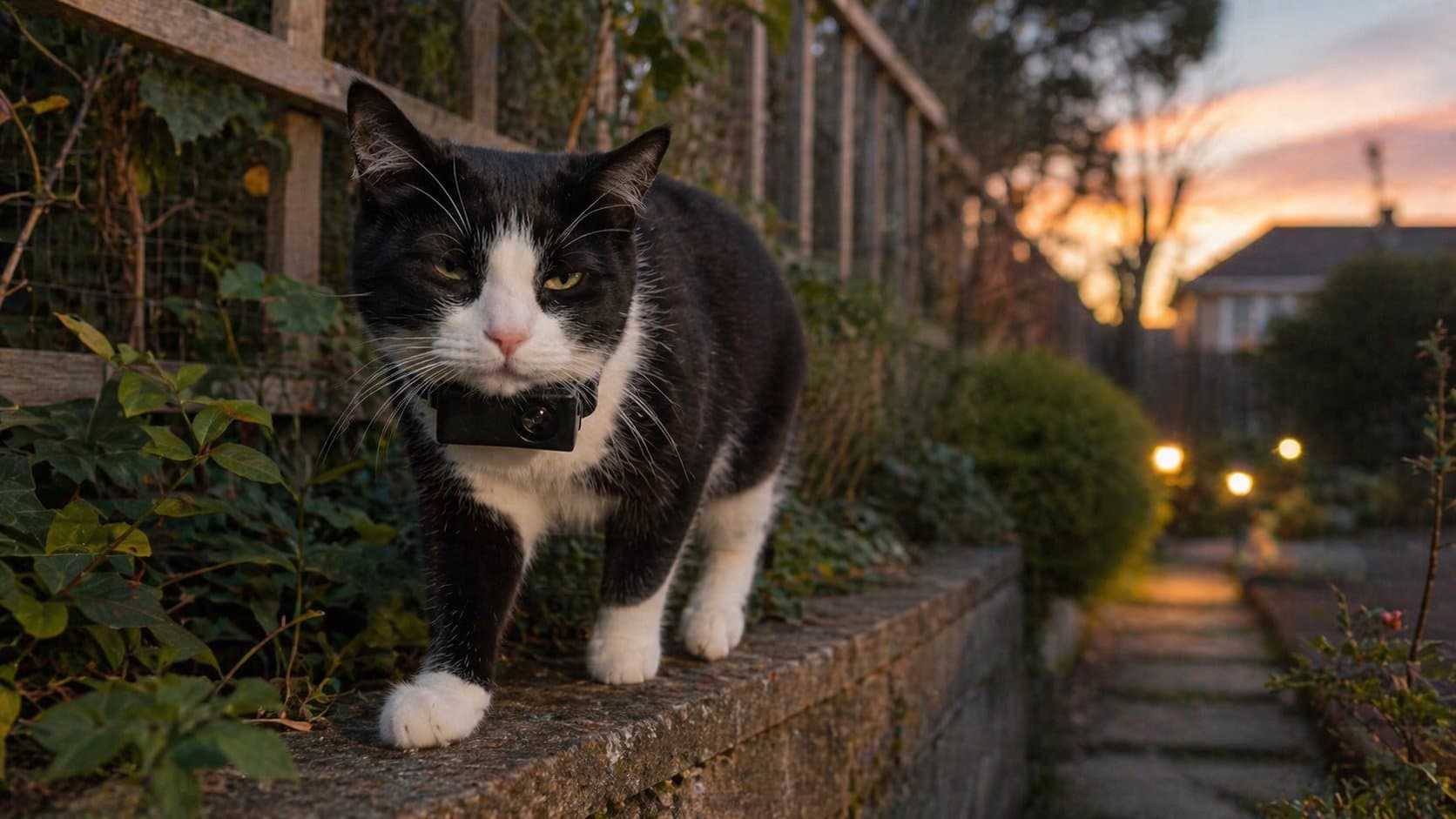
Collar cameras consistently reveal something their owners didn't expect. Across thousands of hours of footage shared by cat owners online, five patterns come up again and again — from secret second homes to unexpected friendships with other cats. Here are the weirdest, with context on why they happen.
Where These Stories Come From
The stories below are drawn from a combination of publicly shared footage on Reddit's cat communities, Facebook groups dedicated to indoor and outdoor cats, conversations with Whiskcam beta testers during the first months of 2026, and patterns that show up across almost every long recording session. Names have been changed. Specific details like age, weight, and timing are preserved because they matter — cat behavior is context-dependent, and vague stories aren't useful. Nothing here is sensationalized. These are the kinds of discoveries that happen quietly, usually during a Sunday afternoon of watching uneventful footage, until a pattern clicks into place.
1. The Second Home (or: "Your Cat Has a Roommate You've Never Met")
Marbles, a 5-year-old domestic shorthair with outdoor access through a cat flap, had what his owner thought was a boring daily routine. Breakfast, garden nap, back inside, dinner. The collar camera said otherwise. For at least 2 hours a day, every single weekday, Marbles was in a neighbor's garage two houses down.
The neighbor — a retired man living alone — had been feeding him small amounts of wet food and letting him nap on an old armchair for about 8 months. He had no idea who owned the cat. Marbles showed up, ate a little, slept, left. The neighbor had assumed he was a stray with a loose collar and had been quietly considering taking him to the vet for a microchip scan.
This kind of discovery is more common than most owners realize. Cats form territorial "secondary home" relationships, especially with humans who consistently provide food, quiet, and warmth. It's not a sign your cat prefers the other person — it's a sign they've expanded their territory to include a second reliable base.
In Marbles' case, the story ended well: a polite conversation between neighbors, a shared feeding schedule, and an informal co-parenting arrangement. A rough estimate from informal owner surveys in dense residential neighborhoods suggests around 22% of outdoor cats have a "secondary feeder" within a three-house radius. Most owners never find out.
2. The Hidden Nap Location Nobody Checks
Pixel, a small 3 kg domestic shorthair living in a one-bedroom apartment, had what her owner described as an "obvious" nap pattern: the armchair in the morning, the bed in the afternoon. The collar camera recorded a third location nobody had thought to check. For roughly 90 minutes every day, Pixel slept in the 8 cm gap between the washing machine and the wall.
The reason is less strange than it looks. That spot offers diffuse heat from the machine cycle, total darkness, no drafts, and a vibration pattern that's predictable rather than alarming. Cats prefer enclosed sleeping spots with vertical walls on at least two sides, and their ideal sleep temperature sits around 26-30°C — meaningfully warmer than what most humans consider comfortable. The appliance gap hit all three conditions.
Interestingly, once summer arrived and the ambient indoor temperature climbed, Pixel abandoned the spot and switched to the inside of the laundry basket. Without temperature tracking, her owner would've never noticed the shift — basket napping looks identical from the outside regardless of whether the cat sleeps 20 minutes there or 90. Collar footage made the seasonal migration obvious.
3. The Staring Session With Another Cat
Luna, a 4-year-old outdoor cat, had what looked like a standing appointment. Every afternoon between 15:30 and 16:00, she climbed onto the same garden wall, sat at the same corner, and waited. Within a few minutes, another cat from somewhere in the neighborhood would arrive from the opposite direction and sit roughly 1.5 meters away.
They didn't fight. They didn't groom each other. They didn't play. They just looked at each other, sometimes for 20 minutes straight, occasionally blinking slowly. Then one of them — usually the visitor — stood up, stretched, and walked away. Luna followed a few minutes later.
Ethologists describe this as a form of mutual gaze signaling: a protocol between cats that know each other and have worked out how to share overlapping territory without physical conflict. It's neither friendship nor hostility. It's closer to two coworkers nodding in a shared office kitchen. Daily, predictable, low-effort, and socially meaningful in a way that's completely invisible to the humans involved.
Luna's owner eventually identified the other cat — a neighbor's 3-year-old named Theo — after catching his collar ID on camera. The two humans had lived on the same street for four years and had never spoken. Their cats had apparently scheduled a daily meeting for at least 18 months.
4. The Food-Stealing Expedition
Biscuit, a 6 kg tabby who was, by his vet's honest assessment, overweight, had been steadily gaining about 200 g every two months for six months. His owner was puzzled — portions hadn't changed, no treats were being handed out, and he seemed to leave some of his kibble in the bowl. The collar camera found the missing calories quickly.
Biscuit was visiting two separate neighbors, both of whom had taken to offering him small snacks when he showed up at the back door. At one house, it was a tablespoon of leftover chicken. At the other, a small handful of commercial cat treats. Neither neighbor knew the other was doing it. Biscuit, evidently, did.
One estimate from owner-reported footage in dense residential areas puts it at roughly 1 cat in 5 receiving food from at least two separate homes on a regular basis. This pattern explains a frustrating portion of the "my cat is mysteriously gaining weight" cases veterinarians see every year. Portion control at home is only half the equation when the cat has an unsupervised 20-minute window outdoors.
Biscuit's story ended with a three-way diplomatic conversation, a shared spreadsheet of daily calorie contributions, and a loss of 400 g over three months.
5. The Thing They're Actually Afraid Of
Mochi, a 2-year-old tabby, had a fear profile her owner was confident about: the vacuum cleaner, the hairdryer, and the doorbell. The collar camera revealed Mochi didn't care about any of those. She stayed on the couch when the vacuum ran. She watched the hairdryer with mild curiosity. The doorbell made her ears twitch and nothing else.
What actually frightened her was an empty cardboard box in the hallway. A plain medium-sized shipping box, open flaps, nothing inside. Mochi made a consistent 3-meter detour every time she walked past it, and on three separate occasions the footage captured her backing away from it slowly, ears flat.
The likely cause is an early aversive association. Mochi had arrived as a kitten in a similar-sized box, taken her first vet trip in a similar-sized box, and been temporarily relocated during a home repair in a similar-sized box. Her brain generalized. From her perspective, cardboard boxes are the shape of bad things happening.
The broader lesson is useful: what our cats avoid is often not what we think they're afraid of. Humans read cat fear through human-shaped assumptions — loud noise means scary. Cats categorize threats by smell, shape, and past association. Collar cameras reveal the actual fear list. It's almost never the list we would've guessed.
Why Collar Cameras Reveal What Regular Cameras Don't
Fixed home cameras — the kind mounted in a corner of the living room — miss almost all of this. Once a cat leaves the frame, the story stops. In practice, a single fixed camera captures maybe 10% of a cat's day, and it's the least interesting 10%. It doesn't follow them to the garage next door, it doesn't sit with them on the garden wall, and it doesn't show you what they're looking at when they freeze in the hallway.
A collar camera follows the cat's gaze. That's the key difference. You're not watching where the cat is — you're watching what the cat is paying attention to. The nuances are real: night vision is limited on most collar cameras, audio is sometimes absent, and the wide-angle lens can distort distances so a far object looks closer. But for behavioral discovery, it's the only tool that works.
For a deeper look at what indoor cats do with their alone time, see our piece on what cats actually do when alone at home.
What to Do With What You Find
Discoveries like these are usually harmless. Three practical notes on how to handle the most common ones:
- Second feeder situations: Start with a non-aggressive conversation. Most neighbors who've been feeding your cat didn't mean to steal them — they're usually relieved to learn the cat has a home. Co-parenting arrangements work surprisingly well when both parties just want the cat to be healthy.
- Hidden nap spots: Leave them alone. If the spot is safe (not behind a running appliance, not near anything hot or pinch-risky), your cat has already chosen it for reasons that make sense to them. Contesting a nap spot rarely ends well.
- Unexpected fears: Don't force exposure. Gradual desensitization — moving the feared object to a more neutral location, pairing its presence with food or positive experiences, not making a point of "proving" it's harmless — is the only approach with reliable outcomes.
Frequently Asked Questions
Do all outdoor cats have a second home?
Most don't. The rough estimate from informal surveys of collar camera footage in dense urban and suburban neighborhoods puts it at 20-25% of outdoor cats having a consistent secondary feeder or resting spot. Rural cats with more spread-out human populations are less likely to develop this pattern. Indoor-only cats obviously don't have one at all.
Is it ethical to film a cat going into a neighbor's property?
Video recording in publicly visible spaces (streets, front gardens, shared alleys) is generally legal in most jurisdictions. Audio recording rules are stricter and vary by country. If your cat regularly enters a neighbor's enclosed space, the respectful move is to mention it to them before reviewing extended footage. Most people find it more funny than invasive once they know what's going on.
How often should I review footage to spot patterns?
Once a week is plenty for most owners. Patterns show up quickly because cats are deeply routine-driven — the same nap spots, the same walking routes, the same social encounters at similar times. Daily review tends to produce fatigue without additional insight. A weekly hour of scrubbing through footage at 4x speed catches almost everything worth catching.
Can I fake these discoveries with shorter sessions?
Not really. Most of the interesting patterns require at least 3-4 hours of continuous recording to become visible. Short 20-minute sessions catch isolated moments, not patterns. The stories in this article all emerged from owners who recorded regularly over weeks — not from one-off clips. Consistency beats length beats resolution, in that order.
The Bottom Line
Collar cameras don't change your cat. They change you. You become a slightly more attentive observer of a small animal that has always had a richer, weirder, more socially complicated life than you assumed. The discoveries are almost never dramatic. They're quiet, specific, and often slightly embarrassing to realize you missed.
If you're curious about recording your own cat's day, the Whiskcam Original is a 26 g collar camera designed for 1080p footage in 1-2 hour sessions — long enough for most of the patterns above to become visible within a few weeks of casual use.