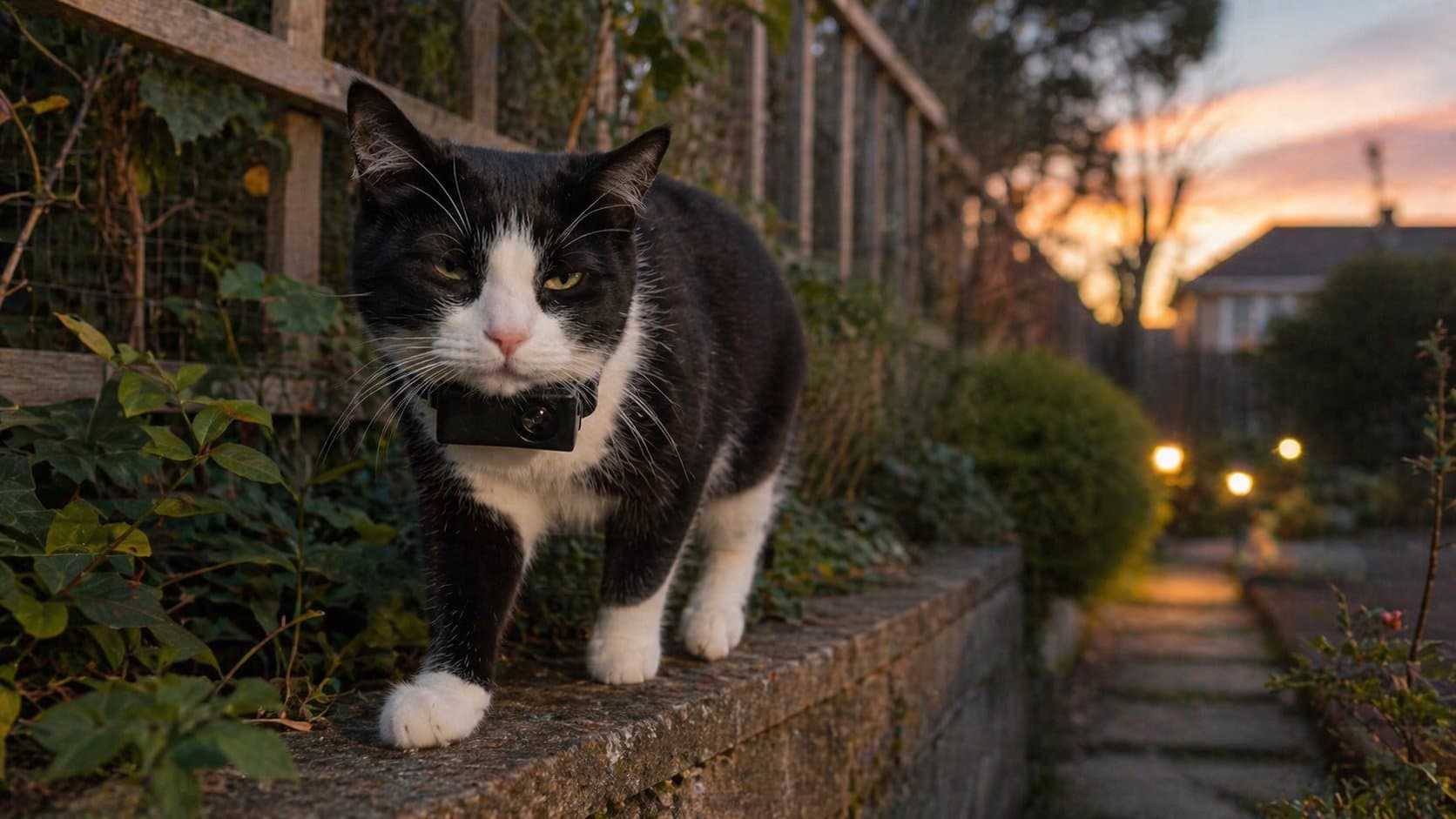
Most outdoor cats spend 80% of their time within 100 meters of home. GPS tracking studies across three continents consistently show a median daily range of 40-200 m for domestic cats — far smaller than owners imagine. The remaining 20% is where things get interesting: second gardens, shared territories, and routes that repeat with startling precision.
When people imagine their outdoor cat's day, they picture long expeditions. The footage and the data say otherwise. Domestic cats are small-range predators with tight routines, and the last fifteen years of GPS research has been quietly dismantling the myth of the wandering housecat. What follows is what multi-university tracking studies have found, what collar camera footage adds on top, and the specific patterns you can expect from your own cat.
The Surprising Science of Cat Range
A handful of academic studies have converged on a consistent picture of how far outdoor cats actually roam. The findings across continents are more similar than different.
- University of Roehampton (Kays et al., pooled international dataset): tracking data from 925 cats across six countries reported a median daily range of approximately 200 m from home, with most individuals staying well under 1 hectare.
- Royal Veterinary College UK: 79 domestic cats in a suburban sample had a mean home range of about 23 hectares (0.23 km²) using 95% kernel density estimation — with the core 50% range an order of magnitude smaller.
- North Carolina State University: in the Cat Tracker project covering 925 owned outdoor cats, roughly 44% of individuals stayed inside a 1-hectare area surrounding their home.
- Nishimura, 2015 (Japan): urban cats showed significantly smaller ranges than rural ones, with dense residential areas producing the tightest territories on record.
The overall pattern: suburban cats tend to range further than tightly-packed urban cats, and rural farm cats — despite the open land available — often stick closer to the barn or house than you'd guess. Intact male cats generally cover 2-3× the area of intact females, and spayed or neutered cats of both sexes show 50-70% smaller ranges than intact counterparts.
A methodological note: none of these studies are definitive. Sample sizes range from dozens to a thousand cats, GPS collars have their own accuracy limits (especially under tree cover), and self-selected study participants skew toward engaged owners. Treat the numbers as directional. The consistency across independent studies is what gives them weight, not any single result.
The Core Territory Pattern
The data from these studies, combined with camera footage, suggests that outdoor cat territory is best understood as four concentric zones. Time allocation is remarkably consistent across individuals.
- Inner territory (0-20 m): the garden, the porch, the immediate surroundings of the home. Cats spend roughly 60-70% of their outdoor time here. This is the zone they patrol most intensely and defend most actively.
- Secondary territory (20-100 m): neighbors' gardens, shared pathways, hedges, and low walls. Around 20-30% of outdoor time. Familiar ground, but not exclusively theirs — often shared with 2-4 other neighborhood cats on a rotating basis.
- Exploration zone (100-500 m): occasional patrols and less-visited corners of the wider neighborhood. 5-10% of outdoor time. Many cats have specific destinations here rather than random wandering.
- Rare excursions (500 m+): weather-dependent, breeding-driven, or triggered by following another cat or a food source. Under 5% of outdoor time for most individuals, and some cats never leave zone 3.
Most outdoor cats never travel more than 500 m from home in their entire lives, even in rural settings. The notion of a cat "disappearing for miles" is usually an artifact of human imagination, not GPS data.
What Cameras Show That GPS Can't
GPS tells you a cat went somewhere. It doesn't tell you why. A dot on a map says "he was at coordinates 48.85, 2.34 for 20 minutes," which is interesting but not actionable. Collar camera footage fills in the motive layer — and the motive is usually the part that matters.
A few examples drawn from combined GPS + camera recordings:
- GPS showed a cat spending 40 minutes inside a neighbor's garage. Camera footage revealed he was sitting directly in front of a heating vent — the garage was simply the warmest accessible spot on a cold morning.
- GPS showed a cat walking the same straight line three times a day, across three gardens. Camera footage showed the cat repeatedly nose-down, following the same scent trail — almost certainly another cat's marking route.
- GPS showed 20 minutes of zero movement in an unusual location. The owner assumed the cat was hiding. Camera footage showed the cat grooming calmly in a patch of afternoon sun, eyes half-closed, completely at ease.
GPS alone gives you location. Camera alone gives you behavioral context without coordinates. Combining both gets you the full picture: where, how long, and — finally — why. For most owner questions, the "why" is the only part that produces actionable changes.
The Time Patterns of an Outdoor Cat's Day
Cats are crepuscular, which means their activity peaks at dawn and dusk. Outdoor cat movement data follows this pattern almost without exception.
- Dawn (05:30-07:30): the largest activity block of the day. Hunting-like behavior, longest-range patrols, highest likelihood of encounters with prey or other cats.
- Midday (11:00-15:00): usually resting, often in the garden, in a shaded spot, or a favorite sun patch. Many cats are functionally invisible during this window.
- Evening (18:00-20:30): a second activity peak, shorter in duration than dawn. Social encounters with other cats are most common here, since overlapping outdoor schedules converge around dusk.
- Night (22:00-04:00): highly variable. Cats that come home to sleep inside are inactive. Cats that stay outside overnight often cover more ground in these hours than during the entire rest of the day — especially unneutered males.
Footage review of multi-night recordings consistently shows that 3:00-5:00 AM is the most common window for feline social encounters: territorial check-ins, shared gaze sessions, and occasional brief confrontations. Almost no humans ever see this.
The Secondary Home Phenomenon
Around 20-25% of outdoor cats in dense residential neighborhoods have what can fairly be called a "second address." This isn't abandonment and it's not preference — it's territory expansion that happens to include another reliable human.
The most common patterns, documented across shared footage and owner reports:
- An elderly neighbor who feeds the cat occasionally, often starting with a single meal and hardening into a routine over months.
- A shed, garage, or greenhouse that's reliably left open and offers warmth, shelter, or predictable shade.
- A second family who considers the cat partly theirs, complete with a nickname that differs from the cat's real one.
The cat, in all these cases, still "belongs" to the primary owner in every meaningful sense — sleeping at home, recognizing the owner's voice, returning for vet visits. They've simply added a second base to their territory in the same way a coworker might have a favorite cafe near the office. A polite conversation between neighbors almost always resolves the situation into an informal shared-parenting arrangement. Details on these discoveries sit in our piece on five weird things people discovered with a cat collar camera.
When to Worry About Range Changes
Most range variation is normal. Cats expand their territory seasonally, shift routes when new cats move into the neighborhood, and develop new preferences over time. A few patterns, though, are worth paying attention to.
- Range suddenly expanded 3× or more: usually a sign of a territory conflict — a new rival cat pushing yours further afield — or a resource change such as a neighbor's feeder closing.
- Missing 48+ hours when previously never absent: worth actively investigating. Possible causes include illness, accidental confinement (garage, shed, basement), injury, or a trap.
- Coming home wet, shivering, or visibly disoriented: may indicate a fall into water, getting locked somewhere cold, or an encounter that needs closer veterinary attention.
- Weight loss combined with wider range: the cat may be hunting harder because a food source has changed — either at home, at a secondary feeder, or through a change in neighborhood prey availability.
- Behavioral change after a range expansion: withdrawal, hiding, reluctance to go out — possible trauma from a near-miss with a car, a dog encounter, or a fight.
How to Map Your Cat's Territory
If you're curious about your own cat's range, you have a few options depending on how much precision you want and how much you're willing to spend.
- GPS tracker (Tractive, Weenect, similar): accurate, passive, runs in the background, reports live location to a phone app. Requires a monthly subscription and adds 25-40 g to the collar.
- Collar camera over 2-3 weeks: shows behavior in rich detail but doesn't give precise coordinates. Best for understanding what the cat does, not where.
- Both combined: the complete picture. GPS for the map, camera for the motive. This is the setup used by most of the research groups doing serious outdoor cat work.
- Citizen science projects: Cat Tracker (UK and US), Pet Tracker, and similar academic programs loan equipment to owners in exchange for data. Free, useful, limited-duration.
For a zero-cost estimate: draw a 100 m radius circle on Google Maps around your house. Based on the research, that's where your cat spends roughly 80% of their outdoor time. Accurate enough for most practical purposes. For a more detailed comparison of tracking options, see our deep dive on cat collar cameras vs GPS trackers.
A Few Famous Cat Ranges
The individual stories behind the data help calibrate expectations. A few documented examples from published studies and shared camera footage:
- Snowy (featured on Upworthy with publicly shared camera footage): a suburban shorthair with a daily range within 300 m of home, almost entirely composed of four specific neighboring properties visited in rotation.
- Mr. Kitters (indoor cat with supervised outdoor access): roughly 30 minutes outside per day, range capped at the single back garden and one adjacent fence-top path.
- Anonymous male farm cat (Roehampton international dataset): a documented home range of approximately 155 hectares — the extreme outlier of the study and more than 300× the median.
The takeaway: outliers exist, and some cats genuinely do roam. But the typical cat is closer to Snowy than to the farm cat, even in environments that would theoretically support wider ranging.
Frequently Asked Questions
How far do outdoor cats typically roam?
Median daily range across the major GPS studies sits between 40 and 200 m from home, with most cats keeping roughly 80% of their outdoor time inside a 100 m radius. Intact males roam 2-3× further than females, and suburban cats range further than urban ones. Ranges over 500 m are uncommon, and ranges over 1 km are rare outliers.
Where does my cat go at night?
If your cat comes home to sleep, almost nowhere — most indoor-nighters are inactive from roughly 22:00 to 04:00. Cats that stay outside overnight often cover their widest ground between 03:00 and 05:00, with the most frequent activity being social encounters with other neighborhood cats on shared walls, paths, and garden boundaries.
Should I keep my cat indoors to limit roaming?
That's a personal decision with legitimate arguments on both sides. Indoor-only cats live longer on average and face fewer road, predator, and fight risks. Outdoor access provides mental stimulation that's hard to replicate indoors. A middle-ground option — catio, harness walks, or supervised garden access — preserves most of the enrichment without the risk exposure.
Can I know where my cat goes without a GPS?
Partially, yes. A collar camera gives you rich behavioral context and identifiable landmarks, even if it doesn't tell you exact coordinates. Combined with neighborhood observation — asking neighbors, checking common cat corridors like fence tops and hedges — you can usually reconstruct the rough territory in a couple of weeks without paying for GPS subscriptions.
The Bottom Line
Your outdoor cat almost certainly roams less than you think. The research is consistent, the camera footage confirms it, and the concentric-zones model holds up across cats, countries, and landscapes. The interesting question isn't whether your cat goes far — it's what they do in the small area they actually use.
For specific stories of what people have found when they started recording, this piece covers five of the most common discoveries. If you want to record your own cat's outdoor day, the Whiskcam Original is a 26 g collar camera built for 1-2 hour sessions — enough to capture a full dawn patrol or evening route in one recording.