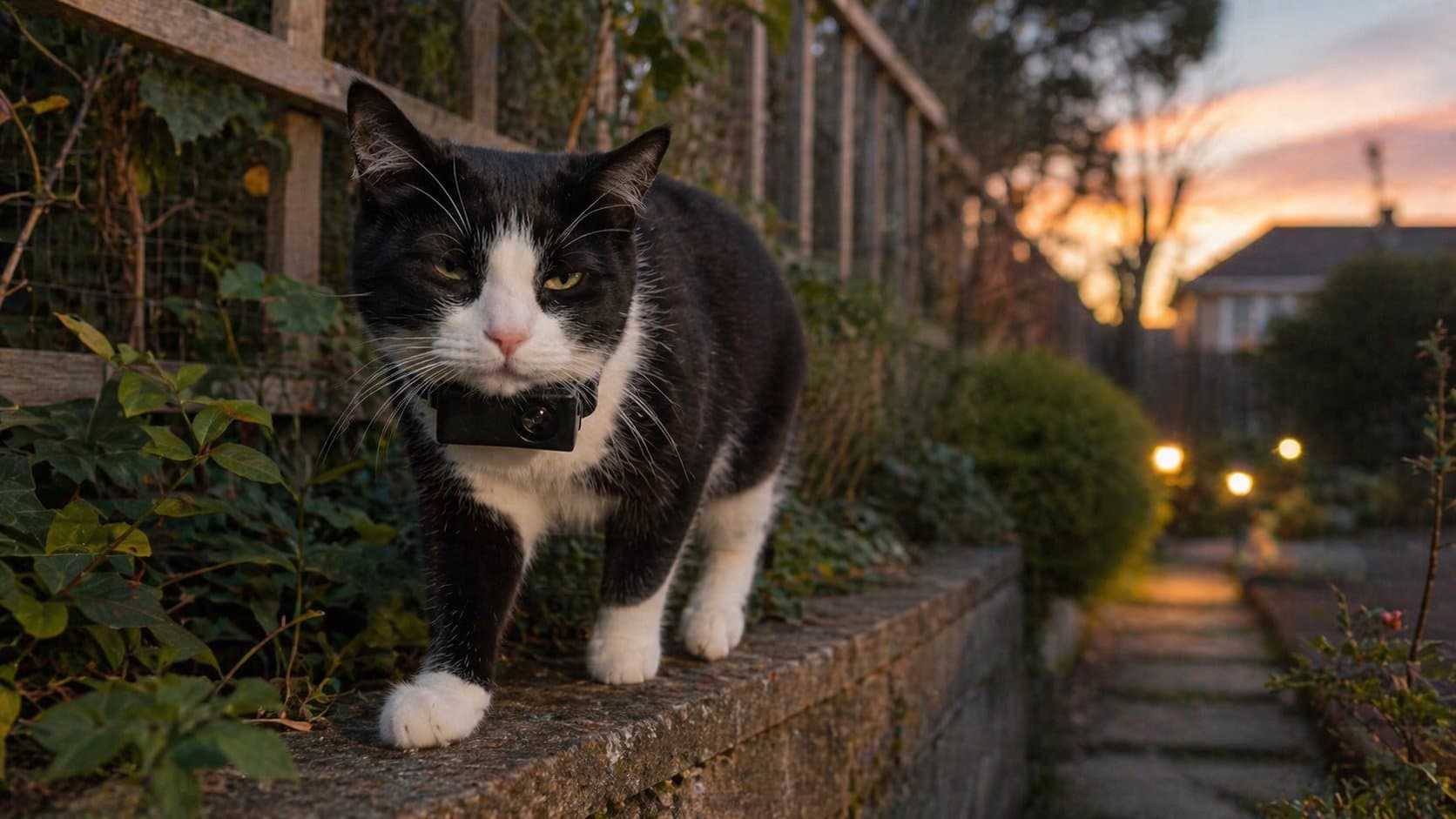
Short version, after testing every cat collar camera we could get our hands on between October 2025 and March 2026: the Whiskcam Original (24 g, €79 complete kit) is the best fit for cats under 6 kg. Mr Petcam (~38 g, ~$70 camera-only) is a fair pick if your cat is bigger and you already own an SD card. Skip the unbranded Amazon clones — half the cameras we ordered showed up broken.
I'm writing this as someone who has clipped a camera to four cats over the past five months — Nori (4.1 kg tabby), Mochi (5.6 kg Bengal), Pablo (3.2 kg rescue), and a Maine Coon called Bear (7.8 kg) borrowed from my brother. The behaviour patterns are consistent: any camera over 35 g and any collar that clips loud earns you about 90 seconds of cat activity before they sit down and refuse to move.
Below is the comparison I wish I'd had before I burned about €240 on cameras that didn't make it past one outing. I work on Whiskcam, so I'll flag where my bias kicks in. The numbers are the numbers either way.
- Period
- October 2025 – March 2026, five months
- Cats
- Four, 3.2–7.8 kg: Nori (tabby), Mochi (Bengal), Pablo (rescue), Bear (Maine Coon)
- Spend
- ~€240 on cameras, several of which arrived broken or failed within one outing
- What we measured
- Weight on the collar, how long the cat kept moving, battery to shutdown, daylight and low-light footage, what was in the box
Scope, honestly: we tested hands-on every camera we could actually obtain. Models we could not buy — noted as such in each section — are assessed from manufacturer specifications and user reviews, not from our own use. We publish this on whiskcam.com and we make one of the cameras compared. Spot an error? support@whiskcam.com.
What Is a Cat Collar Camera?
A cat collar camera is a small, lightweight camera that attaches to your cat's collar and records video from their perspective. Most models weigh between 20 g and 45 g, record in 720P or 1080P, and store footage on a MicroSD card. Unlike pet monitoring cameras (like Furbo or Petcube), collar cameras go with your pet — they capture what your cat sees, not what you see from a fixed camera on your shelf.
The technology is simple: clip it on, press record, retrieve the SD card when your cat comes home. No WiFi, no app, no live streaming. The appeal is the raw, unfiltered footage of your cat's secret life.
Are Cat Collar Cameras Safe for Cats?
Yes, cat collar cameras are generally safe when the camera weighs less than 3-5% of your cat's body weight. For a 4 kg cat, that means a camera under 120-200 g — well within the range of every model on the market (20-45 g). The key safety considerations are:
- Weight: Under 40 g is ideal. Heavier cameras can affect a cat's balance and mobility.
- Collar type: Always use a breakaway collar for outdoor cats. If the camera snags on something, the collar releases.
- Edges: Look for smooth, rounded designs with no sharp corners.
- Monitoring: Start with short indoor sessions (15-30 minutes) and watch for signs of distress — excessive scratching, freezing, or refusing to move.
Most cats adapt within 5-10 minutes and ignore the camera entirely. For a detailed guide, see our full article on cat collar camera safety.
What to Look For in a Cat Collar Camera
Not all collar cameras are equal. Here are the five criteria that separate a useful camera from a waste of money:
- Weight (most important): Under 30 g is ideal for cats. Under 40 g is acceptable. Above 40 g, many cats will resist wearing it.
- Video resolution: 1080P is the minimum for watchable footage. 720P is blurry, especially in motion. 4K is unnecessary — file sizes are huge and no collar camera has a good enough sensor to justify it.
- Battery life: 60-120 minutes is standard. That covers a morning exploration or an evening patrol — the most interesting parts of your cat's day.
- Ease of use: The best cameras are one-button operation. No app, no WiFi, no account creation. If it requires a companion app, it's adding complexity for no benefit on a collar camera.
- Included accessories: SD card, phone adapter, collar/clip. Having to buy these separately adds $15-25 to the real cost.
The Best Cat Collar Cameras Compared (2026)
Here's how the top cat collar cameras compare on the specs that matter:
| Camera | Weight | Resolution | Battery | App Required | SD Card Included | Price |
|---|---|---|---|---|---|---|
| Whiskcam Original | 24 g | 1080P | Up to 2 hours | No | Yes (32 GB) | €79 |
| Mr Petcam | ~38 g | 1080P | ~2 hours | No | No | ~$70 |
| Insta360 GO 3S | 39.1 g | 4K | 38 min (4K) | Yes | No (built-in) | ~$240 |
| Generic Amazon (various) | 25-45 g | 720P-1080P | 60-120 min | Varies | Rarely | $20-45 |
| GoPro Hero (with mount) | 154 g | 5.3K | 73 min | Yes | No | ~$350+ |
Whiskcam Original Review
The Whiskcam Original is a 24 g collar camera that records in 1080P Full HD with a 170° wide-angle lens. It's designed specifically for cats and small dogs, and it comes with everything you need in the box: camera, 32 GB MicroSD card, USB-C/Lightning phone adapter, adjustable collar, and USB-C charging cable.
Pros
- Lightest dedicated collar camera at 24 g — most cats don't notice it
- 170° wide-angle lens captures a natural field of view
- No app, no WiFi, no setup — true one-button operation
- 32 GB SD card and phone adapter included (saves $15-20 vs competitors)
- USB-C charging, full charge in under 1 hour
- Free worldwide shipping, 30-day money-back guarantee
- €79 covers the full kit (camera + 32 GB SD + phone adapter + collar + cable + guide) — most rivals charge à la carte
Worried about the weight on a small cat? We worked through the veterinary guidance in are cat collar cameras safe, and there is a per-breed breakdown in the cat collar weight chart.
Cons
- Up to 2 hours of battery life — enough for morning patrols and evening adventures
- No live streaming (it's offline only)
- AVI video format — may need converting for some editing apps
- New brand — fewer user reviews compared to established competitors
- No night vision
Best for: Cat owners who want simple, lightweight, affordable footage of their cat's outdoor adventures. If your cat weighs under 6 kg and you just want to see what they do, the Whiskcam delivers without overcomplicating things.
Full specification sheet on the Whiskcam Original page, or order the complete kit for €79 with free worldwide shipping and a 30-day money-back guarantee. Disclosure: we make this one.
Mr Petcam Review
Mr Petcam is one of the earliest dedicated pet collar cameras. It records in 1080P, weighs approximately 38 g, and has a similar offline operation (no app needed). It's been around longer than most competitors and has more user reviews.
Pros
- Established brand with more customer feedback
- 1080P recording quality
- No app required
- Works for both cats and dogs
Cons
- Heavier at approximately 38 g — noticeable on smaller cats
- SD card and phone adapter sold separately (~$15-20 extra)
- Higher total cost when you factor in accessories (~$85-90)
- Website and buying experience feel dated
- No night vision
Best for: Owners of medium to large cats (5 kg+) or small dogs who prefer a more established brand. The higher weight is less of an issue on larger animals.
We put the two head to head in more detail — weight, what is actually in each box, and the real total once you add the card Mr Petcam does not include — in Mr Petcam vs Whiskcam.
Insta360 GO 3S as a Cat Camera
The Insta360 GO 3S is an action camera, not a dedicated pet camera. At 39.1 g, it's within the acceptable weight range for larger cats. The video quality is excellent (4K), but battery life drops to about 38 minutes at 4K and 47 minutes at 1080P. It requires the Insta360 app for full functionality.
At approximately $240, it's 5x the price of a dedicated collar camera. It makes sense if you already own one and want to repurpose it, but buying one specifically for your cat is hard to justify.
Generic Amazon Cat Cameras
Amazon has dozens of unbranded collar cameras priced between $20-45. Quality varies wildly. Common issues include: actual resolution lower than advertised, poor audio, plastic clips that break after a few uses, and no included accessories. Some are genuinely 720P despite claiming 1080P. Check reviews carefully and expect to replace them within 3-6 months.
Why a GoPro Doesn't Work on Cats
At 154 g, a GoPro Hero is roughly 6x heavier than a dedicated collar camera. Even the smallest GoPro is too heavy for cats. Some people mount them on large dog harnesses, but for cats, it's not a practical option. The camera would affect your cat's movement, balance, and comfort.
Best Breakaway Cat Collar Camera
If your cat goes outdoors, the breakaway buckle matters more than any spec on the comparison table. Collar entanglement — on a fence, a branch, a gate latch — is the failure mode that actually injures cats, and a few grams either way is irrelevant next to it. A breakaway collar pops open under sustained pull and lets the cat walk away.
Two things to check before buying. First, the camera must clip to the collar rather than being built into it: if the buckle releases, you want the cat free, and the camera detaching with the collar is the correct outcome. Second, the release tension has to be matched to your cat's weight — a buckle stiff enough to hold a 7 kg Maine Coon will not release for a 3 kg rescue.
The Whiskcam ships with a 39 cm adjustable breakaway collar and also clips onto a collar you already trust, which is usually the better option — a collar your cat already wears without fighting it is worth more than a new one. Mr Petcam and the Amazon clones ship camera-only, so the breakaway decision is yours to make separately. Our full safety guide covers introduction and warning signs: are cat collar cameras safe.
The Lightest Cat Collar Camera
Of the cameras in the table above, the Whiskcam Original at 24 g is the lightest — Mr Petcam is around 38 g, the Insta360 GO 3S is 39.1 g with its mount, and a GoPro Hero is 154 g. That ordering held in our testing, and the behavioural difference is not subtle.
Across the four cats, anything over roughly 35 g bought us about 90 seconds of movement before the cat sat down and refused to continue. Under 30 g they carried on as normal. That is the whole argument for weight: not comfort in the abstract, but whether you get footage of a cat doing cat things or footage of a cat sulking on a doorstep. Use the calculator in the safety guide to check the limit for your own cat's weight.
Cat Collar Camera and GPS Tracker Together
These solve different problems and no single device does both well. A camera tells you what your cat did; a GPS tracker tells you where your cat is right now. If your cat is genuinely at risk of going missing, buy the tracker first — a camera is no help in a search.
Running both is possible but the combined load is what matters, not each device on its own. A 24 g camera plus a 25-35 g LTE tracker plus the collar itself lands near 70 g, which is over the conservative 3% limit for any cat under about 2.5 kg. For most adult cats it is fine; for a small cat, alternate them rather than stacking. The full breakdown, including three-year running costs, is here: cat collar camera vs GPS tracker.
Buying a Cat Collar Camera in the UK and Elsewhere
Availability is the practical constraint outside the US. Mr Petcam ships from the US and prices in dollars, so UK and EU buyers should expect customs handling on top of the listed price. The Amazon clones are the easiest to get locally and the least reliable — that is precisely how we lost most of the €240.
The Whiskcam ships free worldwide in 7–14 business days with a 30-day money-back guarantee, priced in euros and converted at checkout. Whichever you choose, check the return path before you order: a camera your cat rejects in the first ten minutes is a common outcome, and it is the return policy rather than the spec sheet that decides whether that costs you anything.
How to Set Up a Cat Collar Camera
Setting up a collar camera takes about 2 minutes. Here's the process:
- Charge the camera fully using the included USB-C cable. Most cameras charge in under 1 hour.
- Insert the MicroSD card (if not pre-installed). Format it first on your computer if it's new.
- Attach the camera to your cat's collar. Most cameras clip on directly. Use a breakaway collar for outdoor cats.
- Test indoors first. Let your cat wear it inside for 15-30 minutes. Watch for signs of discomfort (scratching at the collar, freezing, refusing to move).
- Press record and let them explore. When they come back, remove the SD card and view the footage on your phone or computer.
Frequently Asked Questions
How heavy should a cat collar camera be?
Under 30 g is ideal for most cats. The general veterinary guideline is that anything worn on a cat should weigh less than 3-5% of the cat's body weight. For a 4 kg cat, that's a maximum of 120-200 g, so all dedicated collar cameras (20-45 g) are well within safe limits. That said, lighter is always better for comfort.
Can I leave the camera on my cat all day?
Battery life limits most cameras to 60-120 minutes of recording. Beyond battery constraints, it's good practice to give your cat breaks from wearing the camera. Start with short sessions and work up. Don't leave the camera on overnight.
Do cat collar cameras have WiFi or live streaming?
Most dedicated collar cameras do not have WiFi or live streaming. They record to an SD card that you retrieve later. This keeps the camera lighter (no WiFi chip, no antenna) and simpler to operate. If you need live monitoring, a fixed pet camera (Furbo, Petcube) is a better choice.
What video format do collar cameras use?
Most collar cameras record in AVI or MP4 format at 1080P. Both formats play on any modern phone, tablet, or computer. AVI files tend to be larger but don't require as much processing power to record, which is why simpler cameras prefer it.
Can I put a collar camera on a dog?
Yes. Collar cameras work on dogs too. Weight is less of a concern on dogs since even small dogs weigh more than most cats. The main consideration is the mount — some cameras clip onto collars, while others work better with a harness mount on dogs.
Are the videos good enough for TikTok or YouTube?
1080P footage is perfectly fine for social media. The fisheye/wide-angle look actually works well for the pet POV genre — it emphasizes the immersive, first-person perspective. Pet POV videos consistently perform well on TikTok, with many going viral.
Cat collar camera vs GoPro — which is better for cats?
A dedicated collar camera is better for cats in every practical way. A GoPro weighs 154 g (vs 26-38 g for collar cameras), costs $350+ (vs $50-70), and the video quality difference is irrelevant on social media. The only scenario where a GoPro makes sense is on a large dog with a harness mount.
How much storage do I need?
At 1080P, most collar cameras use approximately 1-2 GB per 10 minutes of recording. A 32 GB card gives you roughly 3-5 hours of footage before needing to transfer files. For typical use (1-2 sessions per day), 32 GB is plenty.
How We Compared These Cameras
The testing basis is summarised at the top of this article: four cats between 3.2 kg and 7.8 kg, October 2025 to March 2026. Cameras we could buy went on a real collar on a real cat, and we recorded weight on the collar, how long the cat kept moving before giving up, battery life to shutdown, and footage quality in daylight and low light.
For models we could not obtain, we worked from manufacturer specifications and cross-referenced user feedback from Amazon, Reddit and pet forums. Those sections say so explicitly — we don't present desk research as hands-on testing.
Transparency note: This article is published on whiskcam.com. We make the Whiskcam Original. We've tried to be fair and honest about both the strengths and limitations of our product compared to alternatives. If you spot an error, email us at support@whiskcam.com and we'll correct it.