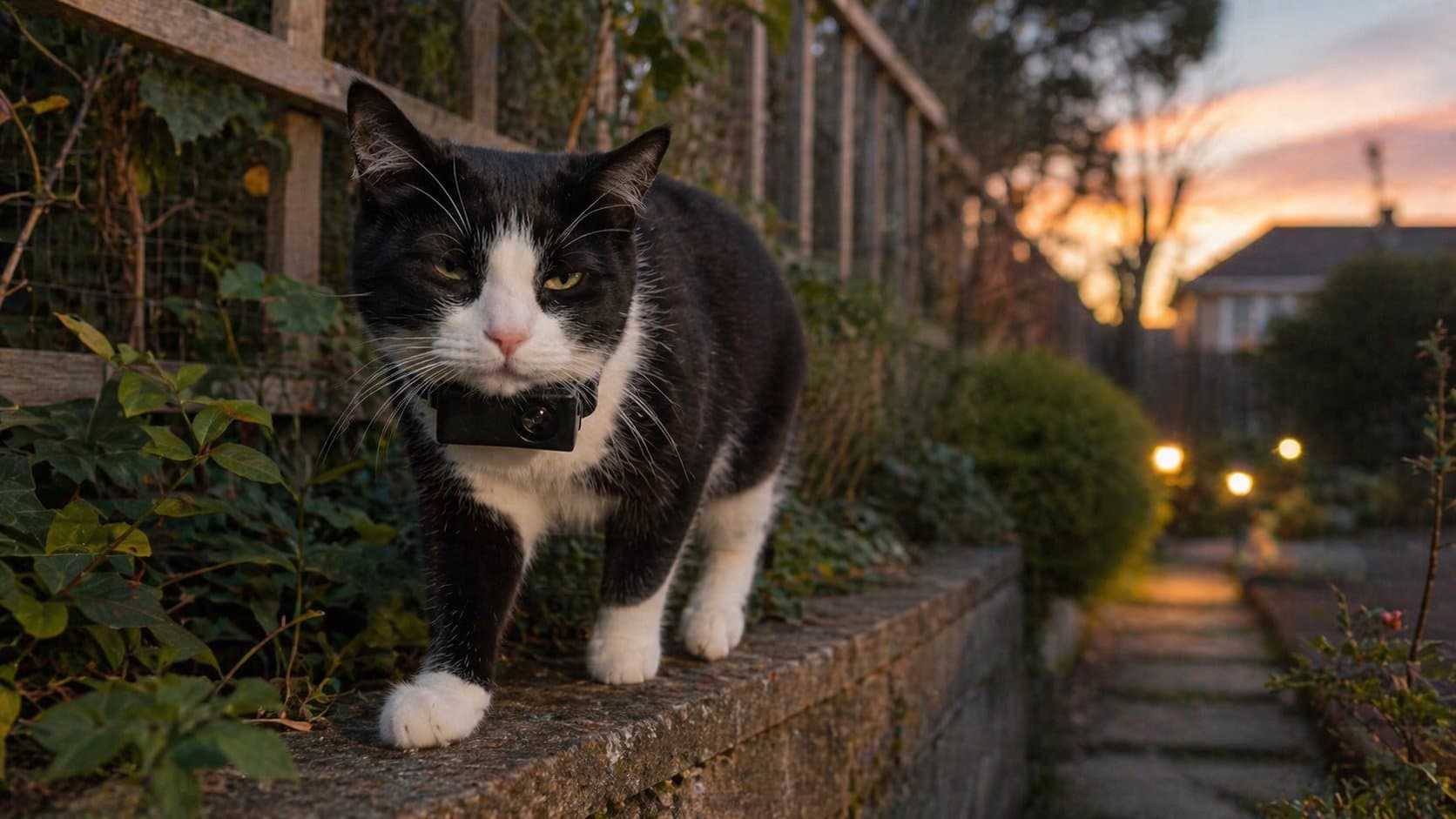
A GPS tracker tells you where your cat IS right now. A collar camera shows you what your cat DID earlier. They solve different problems, they cost different amounts, and most owners actually need one — not both — depending on whether their cat goes missing (GPS) or their cat is a mystery to them (camera). Here's how to decide.
In 2026, cat GPS trackers are a booming category. Tractive GPS Cat LTE (25 g, around $50 plus ~$6/month), Weenect Cats 2, and Eureka Marco Polo all compete for the same outdoor-cat owner. Collar cameras like the Whiskcam occupy a different shelf entirely — but the two products keep getting compared, because both strap to a collar and both promise "see your cat's world." They don't do the same thing.
This guide separates the two, shows the real costs, and helps you pick the one that fits your cat and your budget.
Two Problems, Two Tools
A GPS tracker and a collar camera solve different anxieties.
- GPS tracker = real-time location. If your cat disappears, you open an app and see a dot on a map. You can walk to that dot and find your cat. The device needs a cellular or radio signal to work; it doesn't record anything visual.
- Collar camera = recorded experience. You press record, your cat leaves, your cat comes back, you pull the SD card, and you watch what they did. No live feed, no location data, no subscription.
A useful analogy: a GPS tracker is like Google Maps live location sharing on a phone — you always know where it is, but you don't know what's happening there. A collar camera is like a dashcam — it doesn't tell you where the vehicle is, but afterwards you can review the footage and see exactly what happened.
The two can coexist on the same cat, but they answer different questions. Buying both when you only need one is a waste of money. Buying one when you needed the other is a waste of money too. The rest of this article helps you figure out which.
When You Actually Need a GPS Tracker
GPS is about safety and recovery. Get one if any of these describe your situation:
- Your cat goes outdoor and disappears for more than 4 hours regularly enough that you've started worrying.
- You recently moved house. Cats take 3-6 months to fully imprint on a new territory. During that window, disorientation and runaways are common.
- Your cat has already run away at least once. Behavior repeats.
- You live in an indoor-outdoor zone with dangerous roads, dense traffic, or predators (foxes, coyotes, large dogs).
- You own a high-value breed — Ragdoll, Siamese, Bengal, Maine Coon, Persian — that carries real theft risk in some neighborhoods.
Real costs in 2026: Tractive GPS Cat LTE is roughly $50 for the device plus a subscription of $5-10/month depending on plan length. Weenect Cats 2 is similar in price and structure. Over one year you're looking at $110-170 all-in.
Accuracy: GPS position in open sky is around 5-10 m, with updates every 2-5 minutes on standard plans (live mode drains battery faster and refreshes every few seconds).
The core limitation: a GPS tracker gives you a dot on a map. It does not tell you why your cat is there, who they're with, or what they're doing. If your question is "where is my cat," it answers perfectly. If your question is "what does my cat do," it tells you almost nothing.
When You Actually Need a Collar Camera
A collar camera is about curiosity and insight. Get one if:
- You're curious about your cat's behavior — where they go mentally, who they meet, what they do between meals.
- You're diagnosing a behavior problem. Sudden aggression, stress, over-grooming, compulsive behaviors, or unexplained injuries can often be traced to something your cat encounters while out of your sight.
- You suspect a second household. Indoor-outdoor cats that come home well fed, with a new collar, or smelling different often have a secret second life.
- You make pet content for TikTok, Instagram, or YouTube. Cat-POV footage is a distinct genre and a GPS dot doesn't give you video.
Real costs in 2026: dedicated cat cameras run €50-90 one-time (Whiskcam at €79 for the complete kit, Mr Petcam around $70 for the camera alone). Action cameras like the Insta360 GO 3S reach $240+. Premium options with app ecosystems can push past $450. None of them require a subscription.
The core limitation: 1-2 hours of recording per charge, SD-card retrieval, no live monitoring. You can't use a camera to find a missing cat — the cat has to come home first.
Side-by-Side Comparison
Here's how the two tools compare directly, plus what you get if you run both:
| Feature | GPS Tracker (Tractive LTE) | Collar Camera (Whiskcam) | Both Combined |
|---|---|---|---|
| Real-time location | Yes (2-5 min refresh) | No | Yes |
| Historical route | Yes (app timeline) | No | Yes |
| Behavior insight | No | Yes (video) | Yes |
| Social video content | No | Yes (1080P) | Yes |
| Battery life | 2-7 days active, up to 30d eco | 90-120 min per charge | Two separate charge cycles |
| Weight | ~25 g | ~26 g | ~51 g on one collar |
| Price (year 1) | $110-170 | $50-90 one-time | $160-260 |
| Subscription required | Yes (LTE fees) | No | Yes (for GPS only) |
| Best for | Outdoor cats at risk of going missing | Curiosity, diagnosis, content | Serious outdoor cats, larger body (4 kg+) |
Weight and Safety: Can a Cat Wear Both?
The Tractive GPS Cat LTE weighs about 25 g. The Whiskcam weighs about 26 g. Together, on the same collar, that's roughly 51 g of hardware hanging under your cat's chin. The veterinary 3% rule — no wearable should exceed 3% of body weight — gives us clear numbers:
- 4 kg cat: 51 g = 1.3% of body weight. Comfortably under the 3% limit. Both devices fine.
- 2.5 kg cat: 51 g = 2%. Still under the limit but approaching it. Workable, not ideal.
- 2 kg cat: 51 g = 2.5%. Too close to the ceiling. Pick one device, not both.
- Under 2 kg (kittens): neither device is appropriate. Wait until adult weight.
If you do run both, use a single collar designed for multi-device mounting (some Petsafe and Ruffwear collars have this), not two stacked collars. Two collars on one cat is a snag hazard and doubles the risk of entanglement. For a full breakdown by cat size, see our cat collar weight chart.
Battery Life Realities
The two devices live on completely different charge cycles, and that changes how you use them:
- Tractive LTE: 2-7 days of battery in active tracking mode, stretching to around 30 days in power-save mode. You can leave it on the cat 24/7 and top up weekly.
- Whiskcam: 90-120 minutes of continuous recording per full charge. You cannot leave it on 24/7 — it's a session tool.
The implication: GPS is a background safety layer that's always running. A camera is a deliberate event — you charge it, clip it on, let the cat go, and collect footage. If you're hoping for a "always-on cat bodycam," that product doesn't exist yet at the weight cats can carry. The physics of batteries under 30 g caps recording at roughly 2 hours.
The Hidden Cost Difference Over 3 Years
The sticker price isn't the real price. Subscriptions change the math over time:
- Tractive LTE, 3 years: $50 device + ~$5/month Basic = $230 total. On the Premium tier at $10/month that climbs to about $410.
- Whiskcam, 3 years: €79 one-time for the complete kit. Even if you lose or damage the first unit and buy a second at the existing-customer rate, you stay well under €160 over three years. No monthly.
- Insta360 GO 3S, 3 years: $240-450 one-time depending on kit. Higher sticker, zero recurring.
- Eureka Marco Polo, 3 years: $300-400 one-time for the base kit. No cellular subscription because it uses radio, not LTE — but range is capped at about 3 km line-of-sight.
The honest read: GPS costs more long-term because LTE airtime isn't free. You're paying for real-time. If you don't need real-time — if you just want to know where your cat has been and what happened — a camera is dramatically cheaper over 3 years. If you need GPS but hate subscriptions, Eureka Marco Polo is the middle path, with the range trade-off.
What Vets and Shelters Recommend
Most veterinarians and shelters rank cat safety tools in a specific order. The hierarchy is consistent:
- Microchip — mandatory. One-time $30-60, irreversible, universally scannable at any vet or shelter. Non-negotiable for every cat.
- ID tag on a breakaway collar — always. The cheapest and most reliable way for a neighbor to contact you.
- GPS tracker — optional, risk-based. Recommended for outdoor cats in high-risk areas or after a recent move.
- Collar camera — not a safety tool. Recommended for curiosity, behavior observation, or content creation.
The first three are about recovery if your cat is lost or hurt. The camera is about insight into a cat you already know is home. Don't skip microchip and ID tag for either.
Decision Tree — Which Do You Need?
Walk through these questions in order. The first "yes" usually gives you the answer:
- Did your cat go missing for more than 24 hours in the last year? Get a GPS first. Camera later, if at all.
- Is your cat strictly indoor? Camera only. GPS is wasted — your cat isn't going anywhere you can't see.
- Are you making pet content for social media? Camera only. A GPS dot doesn't help visuals.
- Does your cat have a medical or behavior issue you want to observe? Camera. Footage is what vets and behaviorists can actually analyze.
- New house, new neighborhood, cat still exploring? GPS for the first 3-6 months. Camera optional after they settle.
- Budget capped at $100? Camera. GPS will blow through that on subscription alone within the first year.
- Budget open and serious outdoor concerns? Both, on a collar your cat can actually handle (see weight section above).
If none of these fit cleanly, default to the question: do I worry more about losing my cat (GPS) or not understanding my cat (camera)? That's the honest tiebreaker.
Combining Both: The Setup That Works
For a healthy 4 kg+ outdoor cat, running both is realistic. A practical setup:
- GPS on the primary collar, worn 24/7 as a background safety layer. Choose a breakaway collar with a reinforced attachment point for the GPS module.
- Camera on a secondary session collar, or clipped on for deliberate recording sessions. When the camera goes on, the cat knows the routine. When the camera comes off, they go back to the GPS-only collar.
- Alternative: a single collar with two designated mount points (Petsafe and Ruffwear both offer these). Avoids the stacked-collar snag risk.
Warning: on a small cat (under 3 kg), two devices is too much. The 3% rule isn't optional — respect it even if your cat tolerates the weight initially. Pick one.
Frequently Asked Questions
Can a GPS tracker replace a cat collar camera?
No. They solve different problems. A GPS tracker shows you a moving dot on a map — it tells you where your cat is, not what your cat is doing. A collar camera shows video footage of your cat's activities, but it has no location data and no live feed. Neither replaces the other; choosing between them depends on whether you want to find your cat or understand your cat.
What's the best GPS tracker for cats in 2026?
For most owners, Tractive GPS Cat LTE is the default pick — it's 25 g, LTE-based (so range is effectively unlimited where there's cell coverage), and the app is mature. Weenect Cats 2 is a close alternative, especially in Europe. Eureka Marco Polo is the best no-subscription option but uses radio with a 3 km line-of-sight range limit.
Does Whiskcam have GPS?
No. Whiskcam is a recording-only device — 1080P video to an SD card, no location tracking, no cellular chip, no live streaming. Adding GPS would roughly double the weight and require a subscription, which defeats the "lightweight, one-time purchase" design. If you need location, pair Whiskcam with a dedicated GPS tracker like Tractive.
Can I track my cat without a subscription?
Yes, but with trade-offs. Eureka Marco Polo uses radio signals instead of LTE, so there's no monthly fee — but range is capped at around 3 km in clear line of sight and much less in dense urban or wooded areas. For true unlimited-range tracking, an LTE tracker and subscription are the only real option in 2026.
The Bottom Line
GPS trackers and collar cameras aren't competitors — they're adjacent tools that solve different anxieties. If your cat is at risk of going missing, a GPS tracker is the correct purchase. If your cat is a domestic mystery, a camera is the correct purchase. If both apply and your cat is big enough to carry 50 g of gear, run both on a single well-designed collar. For more on safety and fit, see are cat collar cameras safe or learn about our 26 g option at what is Whiskcam.