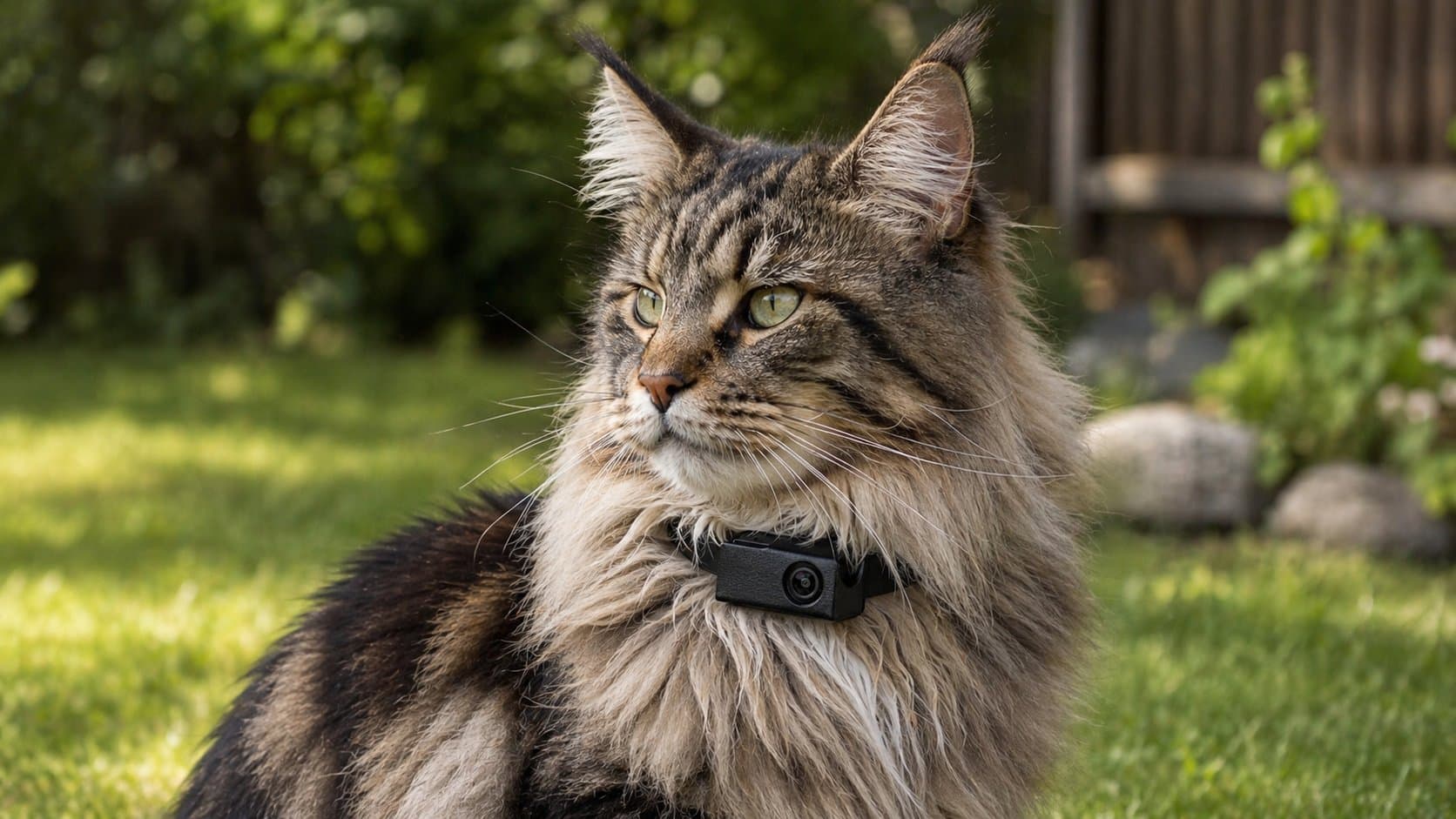
After 7 days of collar camera footage from my 4.2 kg tabby Nori, three things surprised me: she doesn't sleep as much as I thought, she has a second napping spot I'd never seen, and the neighbor's garden is clearly her favorite afternoon destination. Here's the day-by-day breakdown of what I found.
I've lived with Nori for almost three years. She's a domestic shorthair, gray-and-white tabby, 4.2 kg, curious, and she has a cat flap onto a small garden in a quiet residential block. I thought I knew her routine. I was wrong about most of it. This is what 7 days of footage actually showed me — including the parts I got wrong, the battery I forgot to charge, and the moment at 3:47 AM I didn't expect.
Setup — What I Used and Why
I used a Whiskcam Original (26 g, 1080p, 170° lens) clipped onto her existing breakaway collar — a thin 39 cm nylon one she's been wearing since she was a kitten. I added a 32 GB microSD card, which I quickly learned was not enough (more on that at the end).
Nori took about 20 minutes to stop noticing the camera on day one. She sat down, scratched at it twice, then walked off to her water bowl and forgot about it. I had expected a bigger fight. I recorded in 2-3 hour sessions, usually in the afternoon or evening when she's most active, and reviewed the footage the same night.
I wasn't running a study. I wasn't trying to prove anything. I just wanted to see what she did when I wasn't there.
Day 1 — The Patrol Route Nobody Talks About
First recording, 2:10 PM. I clipped the camera on, left for a coffee, and came back two hours later. The first thing Nori did after I closed the door was a full tour of the apartment. It took her almost exactly 8 minutes.
The route was strange to watch from her height. She started at the front door, went along the hallway wall, stopped at the bathroom door (closed), stopped at the bedroom door (closed), stopped at the storage closet door (closed), then looped through the living room and ended up at the balcony window. She sniffed the gap under each closed door for 4-6 seconds before moving on.
Then she did something I still don't fully understand. She walked to the couch, lay down flat on her belly, and looked under it. Forty minutes later, she did it again. Then a third time around 4 PM, and a fourth just before I came home. Four checks of the same spot in under two hours.
At first I thought she'd seen a mouse. I pulled the couch out and found nothing alive — but I did find a small felt mouse toy covered in dust, shoved against the baseboard. I noted it and kept recording. The answer came on day 3.
Day 2 — The Hidden Sleeping Spot
Session 2, same 2-hour afternoon window. About 35 minutes in, the footage got dark-ish and started tilting upward. I thought the camera had slipped. It hadn't. Nori was climbing.
She went up the side of the living room bookshelf — three levels, using the edges of the shelves as steps — to a spot on top that I literally cannot see from the floor. Behind a stack of old photography books, there's a flat area about 40 cm wide. She walked in a small circle, lay down, and stayed there for the next 40 minutes without moving.
The next morning I pulled a kitchen chair over and looked. The spot was lightly flattened. Gray-and-white hair, a lot of it, was caught in the corner where the wall meets the shelf. This wasn't a one-time thing. She'd been sleeping up there for weeks, maybe months, without me ever noticing. The camera showed me somewhere in my own apartment I had never looked.
I left the books where they were. It's her spot. She earned it.
Day 3 — Why She Kept Looking Under the Couch
Day 3 session ran short — I forgot to charge the camera fully the night before and lost about 40 minutes of footage when the battery cut out. Mildly annoying but I still got enough to solve Monday's mystery.
Reviewing the earlier part of the session on a larger screen, I noticed that from Nori's height, lying flat on the floor, you can actually see under the couch at a shallow angle. And at the far edge, just before the baseboard, the felt mouse toy is visible. Small, dusty, and apparently permanent in her mental map of the room.
She wasn't hunting something new. She was checking that the toy she'd lost months ago was still there. Every hour or so, she reconfirmed it. Object permanence research in cats is a whole field, but watching your own cat do this is different from reading about it. It was funny and slightly sad. I fished the toy out with a broom handle and left it on the rug. She batted it once, carried it to the kitchen, and lost it again under the fridge.
Day 4 — The Neighbor's Garden
First outdoor session. I wanted to see what she actually does when she uses the cat flap. Started recording at 1:55 PM, opened the flap at 2:00.
She was out within 3 minutes. The footage through the flap is a blur of fur and daylight, then the camera stabilizes as she crosses our small garden in a straight line. No sniffing, no hesitation, no zig-zag. She's done this a thousand times.
At the back of our garden there's a low stone wall, maybe a meter high. She jumps it in one motion and lands in the neighbor's garden. From there, she walks directly — again, straight line, no exploration — to a spot under a climbing rosebush and sits down. She stays there, mostly still, for about 25 minutes.
The camera shows something I hadn't planned for. About 2 meters from her napping spot, there's a shallow ceramic dish of water under the bush. She gets up once during the 25 minutes, walks over, drinks for 15-20 seconds, and comes back. Then she retraces the exact same route home: rosebush to wall to garden to flap.
I mentioned the water dish to my neighbor a few days later — carefully, because I'd basically been filming her garden. She laughed and said she puts it out for birds but knew a cat drank from it too. Mystery solved. Nori has been commuting to another woman's garden for water for who knows how long.
Day 5 — The 3:47 AM Visitor
This one wasn't planned. I woke up around 4 AM because I heard a low, steady growl from the living room. I looked, saw nothing obvious, went back to bed. In the morning I remembered I'd left the camera on overnight charging back at 10 PM — I'd put it back on the collar around midnight with a low battery that I'd decided to push. Bad idea for battery life, good idea for this one.
At 3:47 AM exactly, Nori walks into the living room and freezes about 50 cm from the window. The footage is grainy — low light, as expected for night — but workable. On the other side of the glass, sitting on our garden wall, is another cat. Black, bigger than her, no collar. They stare at each other without moving. I timed it: 4 minutes, 12 seconds. Neither blinks in a way I can detect.
Then the black cat gets up and walks off. Nori stays at the window for another 20 minutes, totally still, ears forward. She's not growling on the footage audio, but she was earlier — that's what woke me.
I never would have known. I saw nothing out of the window at 4 AM. Without the footage, it's just a weird noise I half-remember.
Day 6 — The Grooming Ritual I Never Noticed
By day 6 I was getting better at scanning footage quickly. I noticed a pattern I had missed: the grooming sequence is almost identical every time.
Across about 6 hours of daytime footage, she spent roughly 14% of the time grooming. That matched the averages I'd read for indoor cats but wasn't the interesting part. The interesting part was the order. Every single grooming session went: front paws first, then face (rubbed with the damp paw), then left flank, then right flank, then tail. Never a different order. Never skipping a step.
I'd never noticed because she almost always grooms tucked behind the couch or on top of the bookshelf. When I'm in the room she does short, partial grooms. The full ritual happens when she's alone. The camera caught it eleven times over the week. Eleven identical sequences.
Day 7 — Final Review: What 7 Days of Footage Tells You
On day 7 I did a longer 3-hour session and then sat down with all the clips from the week. Rough breakdown of her time across roughly 14 hours of usable footage:
- Sleep / rest: about 42%. Less than I expected. I had mentally given her 60-70%.
- Grooming: about 18%. Higher than I expected. The hidden ritual explains a lot of it.
- Window or door watching: about 13%. Mostly the balcony window and the front door.
- Patrolling the home: about 10%. The same route every time, varying only slightly.
- Outdoor time: about 9%. Almost all of it in the neighbor's garden, not ours.
- Eating, drinking, litter: about 8%. Split over 4-5 short visits.
These are rough numbers, not a study. The sample is one cat, one week, one household. But the gap between what I thought she did and what she actually did was big enough to be worth writing down. Before the experiment I would have told you Nori naps all afternoon, occasionally looks out the window, and goes in our garden. All three were approximately wrong.
She tolerated the camera well. Twice during the first two days she tried to scratch it off — once at minute 4 on day 1, once briefly on day 2 after jumping down from the bookshelf. After that she ignored it. I still took the collar off between sessions so she had plenty of camera-free time.
What I'd Do Differently
Three practical things I'd change if I started over tomorrow.
Buy more than one 32 GB card. I ended up erasing footage between sessions because I didn't want to spend an hour transferring files to my laptop every night. I lost some clips I would have liked to compare. A pair of 64 GB cards and a small card reader on the kitchen counter would have solved this for about €20.
Film the evening transition more intensively. My best footage was afternoons, but the most interesting behavior window is probably 8 PM to 10 PM, when Nori shifts from resting mode to active mode. I only caught parts of it. Next time I'd dedicate a couple of sessions specifically to that window.
Keep a paper notebook next to the laptop. I watched hours of footage and kept thinking "oh that's interesting" and then forgetting half of it by the next morning. A physical notebook with timestamps and one-line notes would have doubled what I got out of the experiment. My phone notes app wasn't good enough — too easy to get distracted.
Would I Keep Using It?
Yes, but not constantly. I'm planning to run 1-2 sessions per week of 2-3 hours each, probably changing the time window each time so I cover different parts of her day over a month. After 7 days I already know her baseline pattern. Now I'm more interested in catching exceptions — the nights another cat shows up, the days her routine changes when I'm gone for longer, the occasional visits to the second neighbor's garden (which I suspect but haven't filmed yet).
Using it every day would be overkill and probably annoying for Nori. Once a week, I'd do it again without hesitation.
Frequently Asked Questions
Did the camera bother your cat?
Honestly, barely. About 20 minutes of mild irritation on the first day — a couple of scratches, one head-shake — and then she ignored it. By day 3 she didn't react at all when I clipped it on. I think the breakaway collar helped; she was already used to the feel of wearing something.
What battery life did you actually get?
About 90-120 minutes per session in practice, slightly less than the spec. Cold weather on day 5 seemed to shorten it. The camera also warms up slightly during long recordings, which is normal. I stopped trying to push past two hours on a single charge after day 3's 40-minute gap.
Did you use it at night?
Twice. The footage is grainy — it's a daylight-first camera, not a night-vision one — but workable in a room with any ambient light from streetlamps or a hallway. The 3:47 AM clip was clear enough to identify the other cat and time the standoff. Pitch-dark rooms are unusable.
Is it worth doing for every cat owner?
Depends. If you're curious about your cat and you don't already have a perfect read on her routine, yes — you'll learn things in a week. If your cat is elderly, easily stressed, or you already know her patterns cold, probably not worth it. It's a curiosity tool, not a necessity.
The Bottom Line
Seven days of footage changed how I see Nori. Not because she does anything dramatic — she doesn't. Because the patterns are only visible when you watch them play back. The hidden shelf, the felt mouse, the water dish next door, the identical grooming sequence, the 4-minute stare-down at 3:47 AM. Small things, invisible at the speed of a normal day.
If you want the broader view of what cats do alone, we wrote about the averages across multiple cats in our piece on what cats actually do when alone at home. If you're curious about the camera I used, there's a short page on the Whiskcam Original.