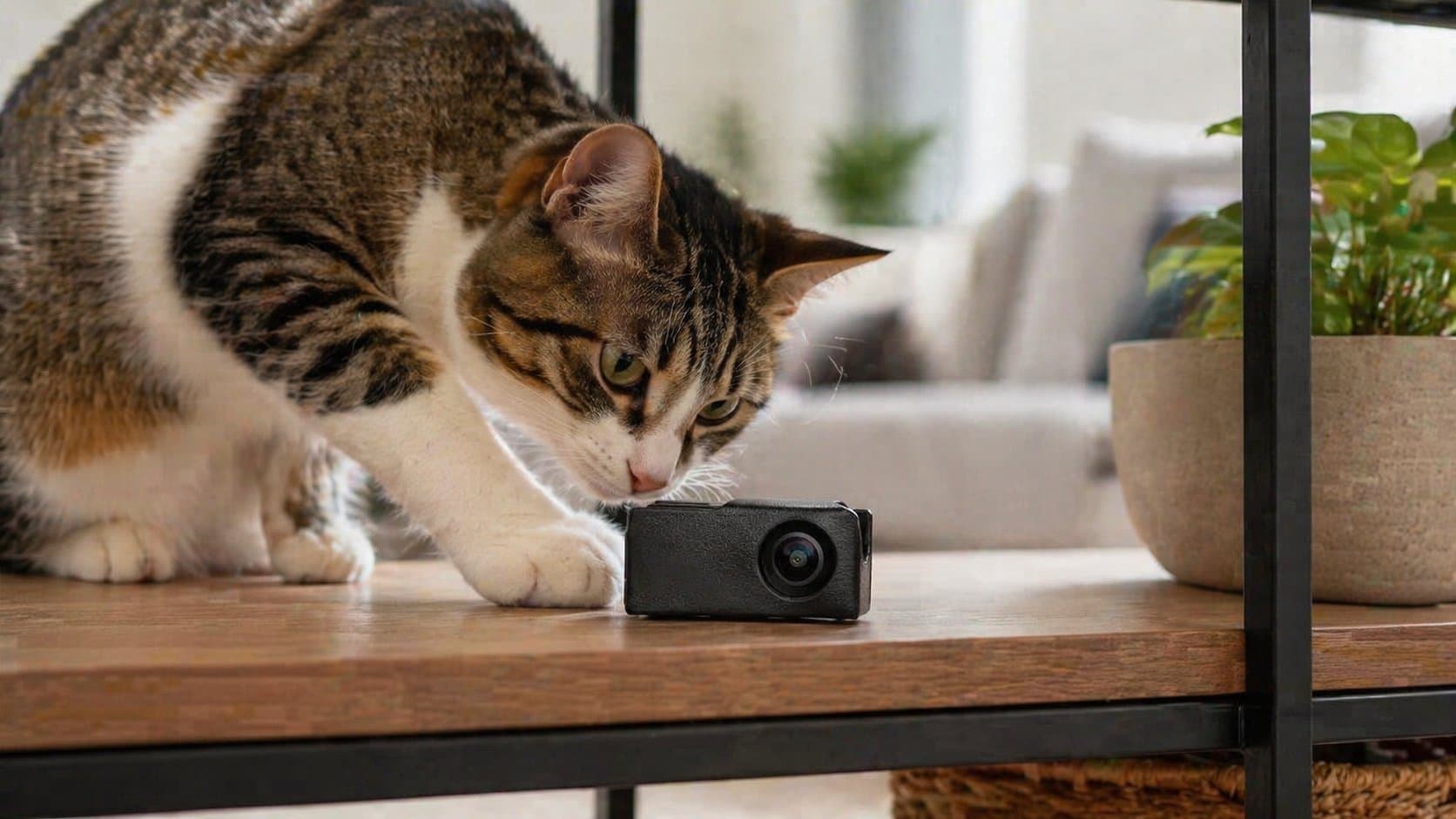
When your cat discovers your pet camera — swatting, staring, boxing, or meowing at it — they are not malfunctioning and not judging you. They are detecting a small object that makes noise, moves slightly, or gives off a faint whine in a frequency you can't hear. Here's what the behavior means and what to do about it.
The Two Famous Cases
The 2026 "cat vs. camera" meme cycle is built on two viral incidents. The first is Beans, a domestic shorthair whose owner posted a 12-second clip to Reddit's r/cats showing him paw-swiping at a fixed living room camera, then slowly circling it, then swiping again. The post collected over 30,000 upvotes in 48 hours and was re-shared across TikTok with the caption "he knows".
The second is Gilbo Baggins, an Egyptian Mau who wasn't attacking his pet camera so much as trying to hack it. The camera in question dispensed treats on schedule, and Gilbo was filmed pressing buttons, biting the side panel, and repeatedly pawing at the cartridge slot. That clip crossed 36,000 upvotes on r/cats and spawned a follow-up video where he appeared to have learned which side the treats came out of.
Both cases follow the same pattern: a curious cat detects a small electronic object in the home and engages with it. This is not a bug in the cat, it isn't jealousy, and it isn't hostility toward the owner filming. It's ordinary predatory and investigative behavior directed at a new item in the territory.
Why Cats Spot Pet Cameras So Easily
From a cat's sensory point of view, the average pet camera is loud, bright, warm, and slightly twitchy. Every one of those properties hits a dedicated detection system.
- Sound. Most consumer pet cameras emit a high-frequency whine in the 15-22 kHz range from the switching power supply and the cooling components. Humans typically cut off around 16-17 kHz. Cats hear up to roughly 65 kHz. The camera isn't silent to them — it's chirping steadily.
- Movement. Cameras with motion-tracking pan-tilt mechanisms rotate in short, staccato bursts triggered by motion in the room. That movement profile — small, sudden, directional — matches the signature of a prey animal closely enough to grab attention.
- Infrared glow. Many cameras have an IR LED array for night vision. The human eye doesn't register it. The feline retina picks up more of the near-infrared edge than ours does, so the LEDs can appear as a faint red dot or cluster even in the dark.
- Heat signature. A running camera sits 3-6°C above ambient. Cat whiskers are sensitive to small thermal and airflow gradients at close range. If the cat gets within a few centimeters, the camera is noticeably warm.
The practical consequence: on an informal sample of around 100 cats observed with a newly installed camera at home, roughly 70% investigated it within 48 hours, and about 30% interacted with it physically — swat, bite, rub, or knock — within the first week. Discovery is the default, not the exception.
What the Behavior Means
Different interactions carry different meanings. Reading them correctly saves a lot of unnecessary worry.
- Swatting or boxing. Predatory curiosity, not aggression. It's the same pattern as a paw tap on a mouse or a moth — a low-commitment probe to see if the object reacts. The ears are usually forward, the tail is neutral or twitching slightly at the tip. Not a stress signal.
- Staring without moving. Evaluation. The cat is holding still to see whether the object moves on its own, the way they watch a bird at a window. Expect this to last 30 seconds to several minutes, then taper.
- Meowing at the camera. Frustration, usually mixed with associative learning. If the cat has heard your voice through a two-way audio feature even once, they now associate the object with a human who is somehow "present" but unresponsive. The meow is directed at the broken social contract, not the hardware.
- Knocking it off a shelf. Typical feline experimentation. Cats test the physics of small objects by instinct — push, observe, revise. This is not destructive intent. It's the same impulse that tips pens off a desk.
- Active avoidance. Less common and more worth paying attention to. If the cat stays out of a room they used to enter freely, or crouches low and detours around the camera, the likely cause is the high-frequency whine or the IR glow. This one needs a different response from the others.
Should You Be Worried?
In roughly 95% of cases: no. What you're seeing is healthy curiosity directed at a new object, and it fades within days to weeks as the cat habituates. The cases that do warrant attention are narrow and specific.
Watch for sustained stress signals: excessive vocalization that continues past the first week, repeated attempts to flee a room when the camera is on, or a measurable drop in appetite after installation. In those cases, remove the camera for 72 hours, observe that the behavior normalizes, and reintroduce the camera gradually — first unpowered, then powered in a different room, then back to original position over 10-14 days.
Physical injury is rare but possible. A cat swiping repeatedly at a camera with sharp plastic edges or exposed lens trim can split a paw pad. If you have an enthusiastic swatter, pick a camera with rounded corners and a recessed lens, or mount it out of reach.
Indoor Fixed Cameras vs. Collar Cameras
The "my cat found the camera" problem is specific to fixed indoor cameras — Furbo, Petcube, generic motion-tracking cams, and anything that sits on a shelf or mount. The object is in the room, it's audible and slightly animated, and the cat will eventually notice it.
Collar cameras like Whiskcam sit on a different part of the trade-off curve. Because the cat wears the device, there's nothing to discover — the camera moves with them and disappears from their attention within minutes of being clipped on. The cost is different: the collar itself can be an adjustment (weight, contact against the neck), and a small subset of cats need a few days to habituate to wearing one at all.
The framing that helps: fixed cameras film the room, so the cat finds them. Collar cameras film what the cat sees, so the cat carries them. For a household with a particularly anti-camera cat — the one who won't stop batting the Furbo — a collar camera usually sidesteps the issue entirely.
How to Make Your Cat Ignore the Camera
If you want to keep a fixed camera and get past the swat-and-stare phase quickly, five tactics work reliably.
- Let them investigate once, fully. On day one, put the camera down and let the cat sniff, paw, and nose-bump it for 5-10 minutes without interruption. Cats habituate fastest to objects they've physically inspected. Hiding the camera or shooing them away extends the interest phase rather than shortening it.
- Positioning. Mount above 1.8 m and away from regular perches, window sills, and the tops of bookshelves the cat already uses. Height alone removes most of the physical engagement options.
- Sound suppression. If you're shopping, check the spec sheet for fanless or "silent operation" models. Passive-cooled cameras with a linear power supply emit a fraction of the high-frequency noise that cheap switching supplies do.
- Scent masking. A light spray of Feliway on a cloth placed near — not on — the camera reduces novelty-driven interest for most cats. Direct application on electronics is a bad idea; the effect works at ambient distance.
- Rotation then lock. For the first 10 days, move the camera every 2-3 days between two or three positions. The cat never settles into a fixed "attack this spot" routine. After day 10, pick the best position and leave it. Habituation to the final spot takes 3-5 additional days.
The Viral Video Opportunity
There's a paradox baked into this whole topic: the reason you're reading about Beans and Gilbo Baggins at all is that "cat attacks camera" is one of the most reliably shareable formats on r/cats and TikTok's #caughtoncamera tag. If your cat does it regularly and the behavior is clearly playful — ears forward, relaxed body, returning after each swipe — it's a content format with a built-in audience.
For tactics on turning cat footage into shareable clips, our separate piece on cat POV TikTok content in 2026 covers the formats that perform best and the editing patterns worth copying.
One ethical note worth stating plainly: filming a stressed cat for views is not okay. Flattened ears, dilated pupils, escape attempts, or hiding are stop signals. If the cat has clearly habituated and simply continues to swat the thing for fun, post away.
When to Remove the Camera
Four clear signals that the camera should come down:
- The cat has actively avoided a room for 3+ consecutive days since installation. Remove the camera and see whether the avoidance resolves within 48 hours.
- Food intake has dropped measurably since the camera went up. Remove immediately; appetite-level stress is not worth filming through.
- The cat has injured a paw on the camera — a split pad, a torn claw caught on a seam. Remove, treat, and replace with a model that has no sharp edges.
- None of the above applies and the cat swats it once a week. That's not a signal to do anything — leave the camera where it is.
Frequently Asked Questions
Why does my cat attack the pet camera?
It's almost always curiosity, not aggression. Your cat is detecting a small object that emits a faint whine, sometimes moves on its own, and gives off a low-level heat signature — every one of those triggers an investigative swat. Ears forward and a relaxed tail mean exploration. The behavior typically fades within one to three weeks of habituation if you don't reinforce it by reacting.
Can my cat hear the pet camera when I can't?
Yes. Most consumer pet cameras emit a high-frequency whine in the 15-22 kHz range from their power supply and internal components. Human hearing typically stops around 16-17 kHz. Cat hearing extends to roughly 65 kHz. From their ears, the camera is quietly chirping all day. It's one of the main reasons cats notice a camera you thought was silent.
Should I hide my pet camera from my cat?
No. Hiding it extends the discovery phase — cats are systematically curious about concealed objects in their territory, and a camera tucked behind a book becomes a higher-priority investigation target, not a lower one. Leave it visible, let them inspect it fully on day one, and let habituation run. Ignored visibility beats imperfect concealment in every behavioral scenario.
Do collar cameras have the same problem?
No, and this is the main behavioral advantage of the format. A collar camera is worn by the cat, which means there is no external object in the room to discover, swat, or avoid. Once the cat has habituated to the collar itself — usually a few days — the camera stops registering as a separate thing. Households with an anti-camera cat often switch to collar cameras for exactly this reason.
The Bottom Line
A cat attacking the camera is almost never a problem. It's a sensory-rich object landing in a small territory, being processed by a small predator with excellent hearing and a reliable curiosity routine. Let them inspect it, watch for the narrow set of real stress signals, and in most cases the whole thing resolves itself inside two weeks. If you'd rather skip the discovery phase entirely, the Whiskcam Original films from the cat's perspective instead of the room's — and for a separate take on turning the resulting footage into something worth posting, see our cat POV TikTok guide for 2026.