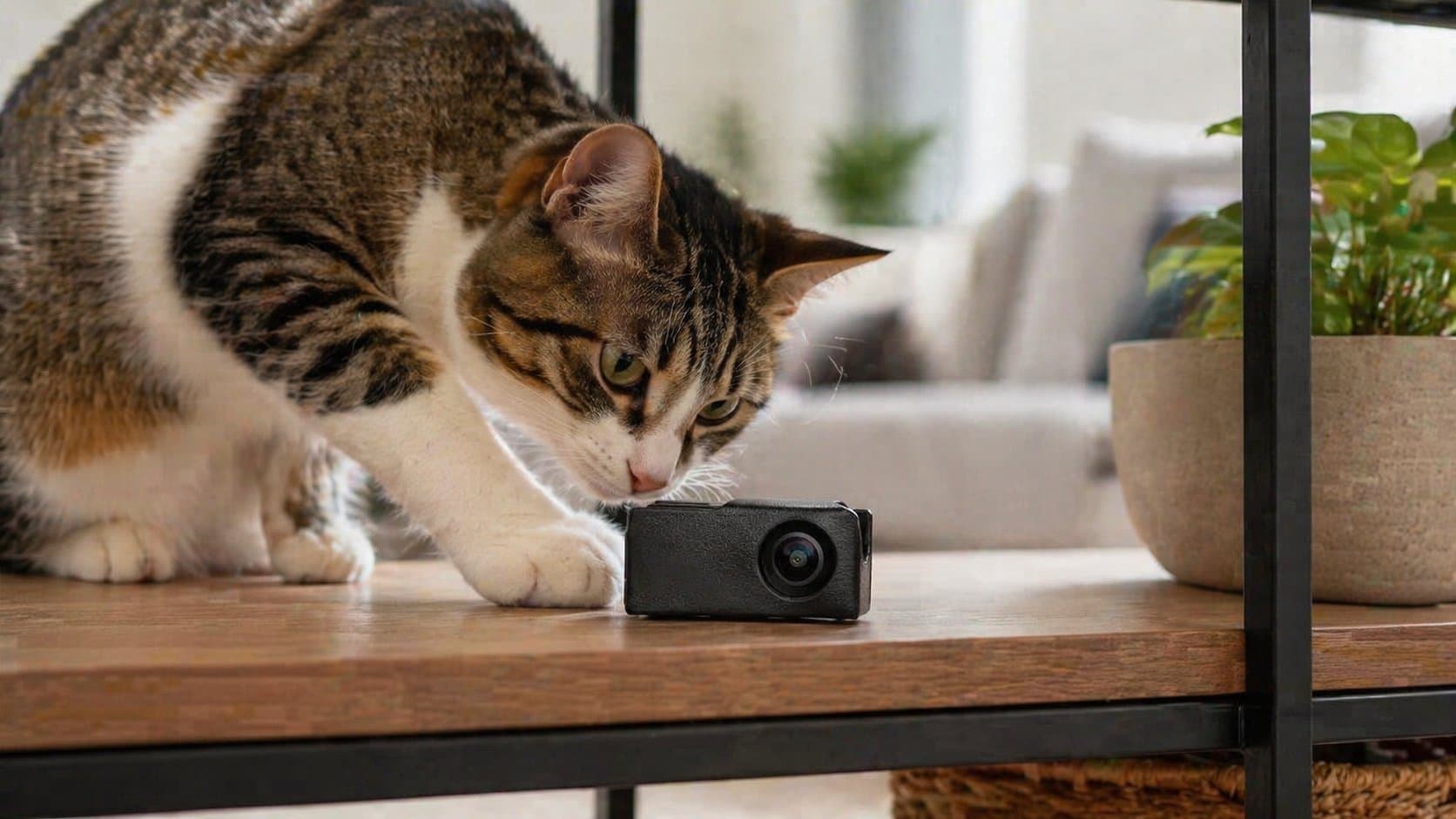
A cat collar plus camera should weigh less than 3% of your cat's body weight for daily use, and 5% maximum for short sessions. For a 4 kg adult cat, that's 120 g maximum for all-day wear (60 g is ideal). Most modern collar cameras weigh 20-40 g, well within safe limits for any healthy adult cat.
The 3% rule is simple in principle but easy to misapply. Owners often weigh the camera but forget the collar and any tag. They use the cat's current weight when the cat is overweight. They apply the rule to kittens or senior cats where it no longer fits. This article gives you the numbers by breed, the edge cases, and the signs that the total weight is wrong.
The 3% Rule Explained
The 3-5% guideline comes from wildlife telemetry research. Biologists strapping GPS collars and tracking devices to wild animals needed a threshold that wouldn't alter the animal's behavior or welfare. Decades of field studies converged on the same number: keep total device weight under 5% of body mass, and under 3% for long-term or continuous wear.
Veterinarians adopted the same threshold for pet wearables — activity trackers, GPS tags, medical collars, and more recently collar cameras. The logic is identical. A device that represents more than 5% of an animal's body weight starts to measurably affect gait, posture, grooming, and stress levels.
For cats specifically, 3% is the conservative daily threshold. 5% is acceptable for short sessions (one to two hours) but not for all-day wear. Below 2%, you're in the "the cat barely notices it" range — which is where most lightweight collar cameras sit on average-size cats.
Weight Chart by Cat Breed
The table below uses the typical healthy adult weight for each breed. If your cat weighs more than the range listed, use the healthy weight, not the current weight (see the overweight section below). A 26 g reference column is included because that's the weight of the Whiskcam Original — most other collar cameras sit in the 20-40 g range, so if 26 g is safe, 40 g is usually also safe with margin.
| Breed | Typical Adult Weight | 3% Daily Limit | 5% Max Session | 26 g Camera Safe? |
|---|---|---|---|---|
| Domestic Shorthair | 4 kg | 120 g | 200 g | Yes (0.65%) |
| British Shorthair | 5 kg | 150 g | 250 g | Yes (0.52%) |
| Maine Coon | 7 kg | 210 g | 350 g | Yes (0.37%) |
| Siamese | 3.5 kg | 105 g | 175 g | Yes (0.74%) |
| Ragdoll | 6 kg | 180 g | 300 g | Yes (0.43%) |
| Persian | 4.5 kg | 135 g | 225 g | Yes (0.58%) |
| Bengal | 5 kg | 150 g | 250 g | Yes (0.52%) |
| Scottish Fold | 4 kg | 120 g | 200 g | Yes (0.65%) |
| Sphynx | 3.5 kg | 105 g | 175 g | Yes (0.74%) |
| Russian Blue | 4 kg | 120 g | 200 g | Yes (0.65%) |
| Norwegian Forest Cat | 6.5 kg | 195 g | 325 g | Yes (0.40%) |
| Abyssinian | 3.5 kg | 105 g | 175 g | Yes (0.74%) |
| Munchkin | 3 kg | 90 g | 150 g | Yes (0.87%) |
| American Shorthair | 4.5 kg | 135 g | 225 g | Yes (0.58%) |
| Burmese | 3.5 kg | 105 g | 175 g | Yes (0.74%) |
Every breed commonly kept as a pet clears the 3% daily threshold by a wide margin with a modern lightweight camera. The tightest case in the table is the Munchkin at 3 kg, which still has 90 g of headroom at the daily limit. That leaves plenty of budget for the collar and any additional tag.
Why You Should Also Count the Collar Itself
The camera weight published by the manufacturer is not the weight on your cat. You need to add everything hanging from the cat's neck. A typical full setup looks like this:
- Nylon breakaway collar: 8-12 g
- ID tag (metal): 3-8 g
- AirTag in silicone holder: 11-14 g
- Collar camera: 20-40 g (Whiskcam is 26 g)
A realistic combined load for an owner who also runs a GPS tag: nylon collar 10 g + Whiskcam 26 g + AirTag 11 g = 47 g. For a 4 kg cat, that's 1.18% of body weight — still well under the 3% daily threshold. For a 2.5 kg cat (small adult), 47 g is 1.88%, which is still safe but closer to the margin. If you run multiple accessories, always calculate the total.
Kittens: Why the Rule Changes
Do not put a collar camera on a kitten under 2 kg. The 3% rule breaks down at that size for two reasons. First, kittens are still developing — their neck muscles, cervical spine, and coordination aren't fully built. Second, even a "safe" 26 g camera is 1.3% of a 2 kg kitten, which sounds low but represents a much larger proportional load on a still-growing skeleton than on an adult.
Wait until the kitten is at least 6 months old and reliably over 2 kg. Before that, a plain lightweight collar alone is the most you should put on them — and many kittens don't tolerate even that. If you want to capture kitten footage, a fixed room camera is the safer option until they grow into collar gear.
Senior Cats: Tighter Threshold
Cats aged 10 and older often have reduced mobility, early-stage arthritis, or subtle cervical stiffness that isn't yet diagnosed. For these cats, tighten the daily limit from 3% to 2% and keep sessions short — 30 to 45 minutes rather than multi-hour wear.
On a 4 kg senior cat, 2% is 80 g of total collar weight budget. That's still comfortably above a 26 g camera plus a collar, but it leaves less room for added accessories. Senior cats are also the group most likely to show early signs of discomfort in posture or gait, so introduce the camera gradually and check in after every session. If your cat has a diagnosed spinal or joint condition, consult your vet before using any collar accessory.
How to Weigh Your Cat Accurately at Home
Before you calculate anything, you need an accurate current weight. Three methods work, in order of accuracy:
- Vet visit. Most accurate. Vet scales are precise to 10 g and calibrated. Most vets will weigh your cat at no charge between appointments.
- Dedicated pet scale. A digital pet scale (often sold for puppies or small animals) is precise to 10-50 g and costs 25-50 USD. Worth it if you plan to track weight over time.
- Bathroom scale, two-step method. Weigh yourself. Then weigh yourself holding your cat. Subtract. Accurate to roughly 100-200 g depending on your scale.
Useful trick for uncooperative cats: place the cat in their carrier, tare the scale to zero with the empty carrier first, then put the carrier (with cat inside) back on the scale. You get the cat's weight without any wrestling. Avoid weighing right after a meal or a litter visit, when weight swings by 100-300 g.
What Happens If the Camera Is Too Heavy
When the total collar load exceeds the comfortable threshold, cats show it in four concrete ways. Watch for these during the first few sessions:
- Low posture. The cat walks with head and shoulders lower than usual, sometimes crouching to move. Normal for the first 2-3 minutes of a new collar; a problem if it persists beyond 10.
- Refusing to move. The cat sits or lies in one spot and won't walk. Not hiding, just frozen. This is a clear overload signal.
- Excessive grooming. Obsessive grooming around the neck or shoulders past the normal adjustment period suggests the cat is trying to remove a foreign load they can't lift off.
- Changed gait. Stumbling, swaying, or short stiff steps. Rare with properly sized cameras, but a red flag when it happens. Remove immediately.
Most of these signs are temporary and pass within 10-15 minutes as the cat adapts. If they persist or worsen, the weight is wrong for that cat — either the camera is too heavy for their body size, or something about the fit is distributing the load poorly.
Frequently Asked Questions
Is 40 grams too heavy for a 3 kg cat?
40 g on a 3 kg cat is 1.33% of body weight — well under the 3% daily threshold (which would be 90 g). It's safe, but you're closer to the margin than with a lighter camera. For smaller cats under 3.5 kg, cameras in the 20-30 g range give you more headroom for the collar, a tag, and any other accessory.
Can overweight cats wear heavier cameras?
No. The 3% ratio is based on the cat's healthy target weight, not their current weight. An overweight 6 kg cat whose healthy weight is 4 kg should use the 4 kg limit (120 g total), not the 6 kg limit (180 g). Their skeleton and joints are sized for the healthy weight. Using the current weight gives a false safety margin.
Should I remove the camera at night?
Yes. Collar cameras are designed for active monitoring sessions, not continuous wear. Give your cat several collar-free hours daily, and always remove the camera at night and when the cat is fully supervised indoors. 24/7 wear causes unnecessary fur matting, potential skin irritation, and reduces the cat's overall comfort.
What's the heaviest cat collar camera currently sold?
Most waterproof or ruggedized collar cameras sit in the 40-60 g range. A few outdoor models aimed at hunting cats or small dogs reach 70-80 g. For a 4 kg cat, 70 g still clears the 3% threshold, but by a narrower margin — factor in the collar, tag, and any AirTag before buying in that range.
Does fur thickness affect perceived weight?
Not scientifically. Thick fur (Maine Coon, Persian, Norwegian Forest Cat) may distribute and cushion collar pressure slightly, but the gravitational load is identical. What fur does change is visible fit — a collar that looks loose on a fluffy cat may actually be correctly snug against the neck underneath. Measure under the fur, not over it.
The Bottom Line
For any healthy adult cat over 2.5 kg, modern lightweight collar cameras (20-40 g) are well within safe weight limits. The 3% daily rule gives you a simple check: multiply your cat's healthy weight in kg by 30 to get the total collar budget in grams. Add up the collar, tag, and camera — if the total is under that number, you're safe.
For a deeper look at the other safety factors beyond weight, read our guide on whether cat collar cameras are safe. If you want to see what cats actually do while wearing one, we reviewed footage in what cats do when alone at home. Or learn more about the Whiskcam Original, our 26 g collar camera built for cats and small dogs.